

Buying a separate travel insurance policy for every trip you take this year might actually be the most expensive way to protect yourself. You're likely familiar with the frustration of re-entering your medical history for the third time in six months or worrying if your inter-provincial coverage has gaps while visiting family in BC. It's exhausting to track different stability periods and expiry dates when you just want to enjoy your time away from the GTA. When researching annual travel insurance Canada travellers often discover that the convenience of a single policy provides a level of freedom that individual plans simply can't match.
We understand that you want your travel planning to be effortless and your coverage to be certain. This guide will show you exactly how annual multi-trip plans work and help you find the "breakeven" point where one policy offers more value than several individual ones. We'll break down the 2026 requirements for medical stability, explain how to simplify your planning for the year, and ensure you feel confident that your specific health needs are covered. By the end, you'll have a clear path to securing your peace of mind for every flight, road trip, and weekend escape on your calendar.
Key Takeaways
- Learn how to apply the "Three Trip Rule" to determine if a multi-trip plan offers better value for your yearly travel frequency than buying separate policies.
- Understand how trip duration limits work for annual travel insurance Canada and how to select the right 15, 30, or 60-day window for your typical departures.
- Discover how to navigate medical stability periods so you can travel with confidence that your pre-existing conditions are fully recognized by your insurer.
- Identify the specific gaps in OHIP coverage that make supplemental travel insurance a necessity for Ontario residents, even for trips within other Canadian provinces.
- See how a local brokerage can help you compare multiple insurance carriers to find the specific policy wording that matches your unique health history.
What is Annual Travel Insurance for Canadians?
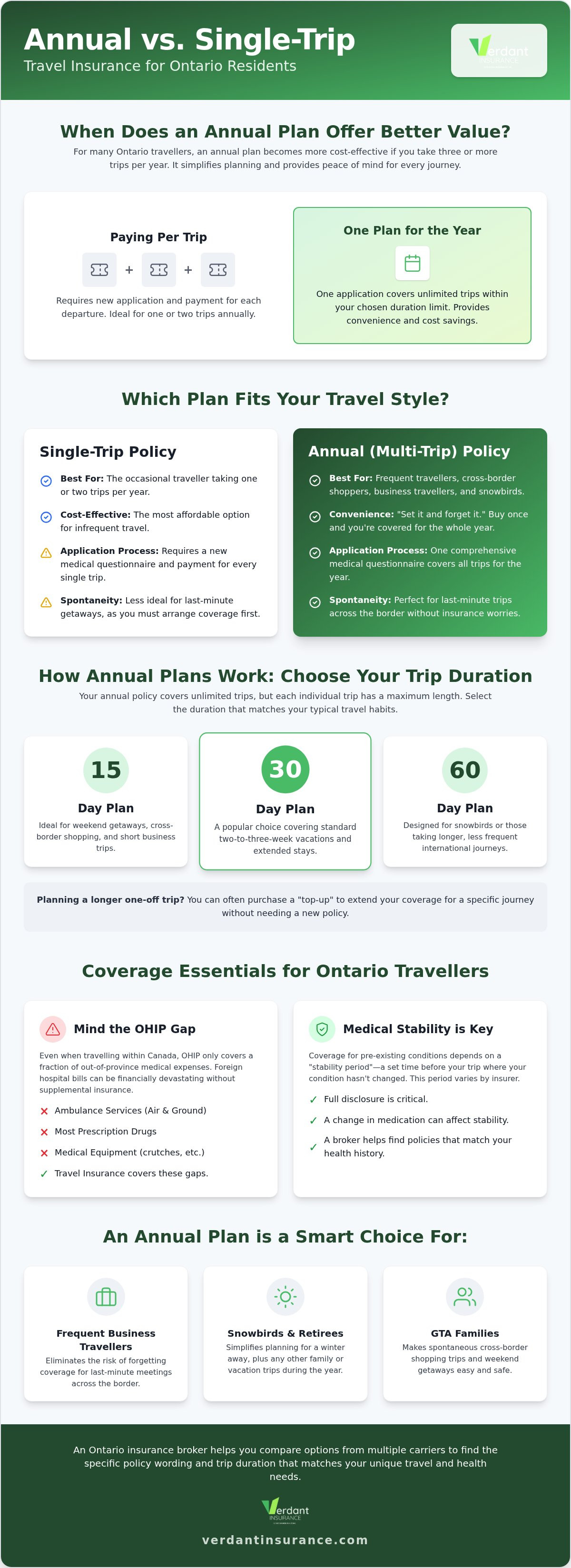
Annual travel insurance, often called a multi-trip plan, is a single policy that covers an unlimited number of trips taken within a one-year period. Unlike a single-trip policy that expires the moment you return home to Ontario, an annual plan stays active for a full 365 days. If you're researching what is travel insurance?, you'll see these plans are built for efficiency. You buy it once, and it's ready every time you cross the border, whether you're heading to Buffalo for a day of shopping or flying to Europe for two weeks. It's a proactive way to manage annual travel insurance Canada needs without the repetitive hassle of multiple applications.
These plans simplify your departure process by removing the administrative burden of travel prep. You don't need to call a broker or fill out a new medical questionnaire every time you book a flight. As long as your trip falls within the duration limits of your policy, you're covered. This "set it and forget it" approach is ideal for people who value their time as much as their protection, providing a seamless transition from your home in the GTA to your destination.
The Role of OHIP in Travel Insurance
A common misconception among Ontario residents is that OHIP provides comprehensive protection outside the province. In reality, the Ontario Health Insurance Plan covers only a very small fraction of medical costs incurred abroad and often won't pay foreign hospitals directly. Most annual travel insurance Canada policies actually require you to have an active provincial health plan to be eligible for coverage. The private insurance acts as a vital bridge, handling the massive emergency medical costs that OHIP simply wasn't designed to touch. Without this supplemental layer, a single night in a U.S. hospital could lead to tens of thousands of dollars in out-of-pocket expenses.
Who Benefits Most from Multi-Trip Plans?
Multi-trip plans offer significant logistical advantages for several types of Ontario travellers who find themselves leaving the province more than twice a year. They aren't just for global jet-setters; they're a practical tool for everyday life in a border province.
- Frequent Business Travellers: If you're often crossing the border for meetings in Detroit or New York, having one policy eliminates the risk of forgetting coverage during a last-minute trip.
- Snowbirds and Retirees: For those planning a few weeks in Florida followed by a summer trip to the East Coast, an annual plan simplifies the process and ensures consistent protection.
- GTA Families: Families in Markham, Vaughan, or Richmond Hill who enjoy weekend cross-border shopping trips or quick getaways find that a single annual policy is much easier to manage than individual quotes.
By securing a multi-trip plan through an Ontario brokerage, you ensure that your policy is tailored to our province's specific regulatory environment. It's about creating a frictionless travel experience where the insurance is already waiting for you, regardless of how many times you decide to pack your bags.
How Multi-Trip Plans Work: Trip Durations and Limits
An annual plan is essentially a collection of shorter coverage windows. While the policy stays active for a full year, each individual trip has a specific "trip duration" limit. Most insurers in Ontario offer standard options such as 4, 9, 15, 30, or 60 days. This means every time you leave the province, your coverage clock starts ticking. If your plan has a 15-day limit, you must return to Ontario before that 15th day concludes for the coverage to remain valid for that specific journey. It's a proactive way to manage annual travel insurance Canada needs without buying a new policy every month.
What happens if your trip lasts longer than your plan allows? This is a common point of confusion. If you stay away for 16 days on a 15-day plan without notifying your insurer, you may have no coverage for any medical emergency that occurs after your limit expires. Some insurance carriers might even deny a claim entirely if the trip duration was exceeded from the start. To avoid this, you can often "top-up" your plan. This involves paying a small additional premium to extend the coverage for a specific long-duration trip, allowing you to keep your annual policy while staying protected for a one-off 30-day vacation.
Choosing Your Maximum Trip Duration
Selecting the right limit is a balance of your travel habits and the premium cost. A longer trip duration limit typically increases the cost of your annual policy because the insurer is covering a longer window of risk per departure. For many residents in Markham, Richmond Hill, or Vaughan, a 4 or 9-day plan is perfect for frequent cross-border shopping trips or short business meetings in the United States. However, if you typically take a two-week summer getaway, a 15-day limit is a safer baseline. If you're unsure which duration fits your lifestyle, a Markham insurance broker can help you compare options from different partner carriers.
The Importance of the Departure Date
Your 365-day policy window is separate from your individual trip dates. The policy year begins the day you purchase or activate it, but each trip's duration is tracked from the moment you leave Ontario. According to Government of Canada travel advice, it's vital to have proof of your departure date for every trip. Insurers may request this proof during a claim to verify you haven't exceeded your trip limit. Common ways to prove your departure include:
- A stamped passport or airline boarding pass.
- A dated receipt from an Ontario gas station or duty-free shop at the border.
- A hotel or meal receipt from your destination on day one.
Understanding these mechanics ensures that your annual travel insurance Canada policy works exactly when you need it most, providing a seamless experience for every trip you take during the year.
Annual vs. Single-Trip Insurance: Which Offers Better Value?
Determining whether to buy a single-trip policy or an annual plan usually comes down to the "Three Trip Rule." For most Ontario residents, if you plan to leave the province three or more times in a 365-day period, a multi-trip plan typically offers better value. This isn't just about the premium cost; it's about the total cost of your time and the risk of being uninsured. When looking for annual travel insurance Canada travellers often find that the cumulative cost of three separate policies equals or exceeds the price of one year-long plan. Even if you only take two major vacations, a single spontaneous cross-border shopping trip to Buffalo can suddenly make the annual plan the more sensible financial choice.
Age and health status also play a significant role in this value proposition. For older travellers or those with managed health conditions, the process of completing a medical questionnaire for every individual trip is time-consuming and carries the risk of inconsistent answers. According to the Travel Health Insurance Association of Canada, understanding your policy's specific terms is vital for ensuring coverage. By choosing an annual plan, you lock in your medical stability requirements once for the entire year, providing a much higher level of certainty for your excursions.
Calculating the Breakeven Point
To find your personal breakeven point, consider your planned itinerary for the next 12 months. Imagine a scenario where you have two 10-day trips scheduled. While two single-trip policies might be slightly less expensive than an annual plan, the annual plan provides a safety net for any other departures. If you decide to visit family in another province or take a last-minute weekend getaway, you're already covered. You should also factor in the cost of "top-ups." If your annual plan covers 15 days but you decide to take one 21-day vacation, paying for those six extra days is often more affordable than buying a standalone 21-day policy from scratch.
Administrative Convenience vs. Premium Costs
One of the most overlooked benefits of annual coverage is the reduction of administrative stress. Managing one renewal date through your Ontario insurance broker is significantly simpler than hunting for quotes every few months. This consistency ensures there are no gaps in your protection. It's common for frequent flyers to focus strictly on the premium, but the value of "insurance on demand" is high. You won't risk forgetting to buy coverage for a short 48-hour trip, which is often when travellers are most vulnerable. By consolidating your annual travel insurance Canada needs into one policy, you gain a simplified travel routine that lets you focus on the trip itself rather than the paperwork.
Understanding Eligibility and Pre-existing Medical Conditions
Your health history doesn't have to be a barrier to seeing the world, but it does require a careful look at the fine print. When securing annual travel insurance Canada travellers must pay close attention to the stability period. This is a fixed timeframe before your departure date where your medical condition must remain unchanged. Depending on your age and the specific plan, this period is typically 90 or 180 days, though it can vary by insurer and individual circumstances.
One unique feature of annual plans is that this stability clock resets every time you leave Ontario. If you have a stable condition during a trip to the United States in January, but your doctor changes your prescription in February, that condition may not be covered for a March getaway. You don't need a new policy, but you do need to be aware of how your recent medical history aligns with your next departure date. This ensures your protection remains intact for every trip on your calendar.
The Stability Requirement Explained
Specialist visits in the GTA often lead to new recommendations or tests, which can inadvertently break your stability status. A change in health isn't just a new diagnosis; it includes dosage increases, switching to a generic version of a drug, or even a physician suggesting a new investigation. In standard Ontario insurance terms, a condition is considered stable when there have been no new symptoms, no changes in medication or treatment, and no pending medical investigations within the required timeframe before departure. Even a dosage decrease is often viewed as a change by insurers, so it's vital to track these adjustments closely before you head to the airport.
Eligibility for Ontario Residents
To qualify for these plans, you must be a permanent resident of Ontario and maintain active OHIP coverage for the full 365 days of the policy. If you're a snowbird spending significant time away, ensure your provincial health status remains in good standing, as your travel insurance typically becomes void if your provincial coverage lapses. For those over age 60, a medical questionnaire is usually required. This document determines your eligibility and helps your broker find a carrier whose stability requirements match your specific health profile. If your health changes mid-year, you can usually keep your policy, but you must consult your broker to see how it affects coverage for your upcoming trips.
Choosing the Right Multi-Trip Plan with an Ontario Broker
Buying directly from a single insurance company or a big bank limits your options to just one set of policy wordings. They can only offer you their specific rules and exclusions, which might not align with your health history or travel frequency. A local brokerage in Markham provides a neutral comparison of multiple partner carriers. This perspective is vital for annual travel insurance Canada because every insurer handles pre-existing conditions and stability periods differently. Instead of trying to fit your life into one company's rigid framework, a broker finds the carrier that accommodates your unique circumstances.
It's also essential to ensure your annual plan includes trip cancellation and interruption coverage. While many travellers focus primarily on emergency medical protection, an annual multi-trip plan can also safeguard your non-refundable deposits for every journey you book during the year. For residents in York Region, Richmond Hill, and Vaughan, this added layer of security ensures that a sudden illness or a family emergency doesn't result in a total financial loss for your planned getaways.
The Advantage of a Professional Brokerage
A professional broker acts as your advocate, helping you interpret the complex "fine print" that often leads to denied claims. Since stability periods can range from 90 to 365 days depending on the insurer, having a broker who can access different carriers is a significant advantage. If your health status makes one company's requirements too restrictive, we can look for a partner with more flexible terms. We also provide expert guidance during the claims process, ensuring you have a supportive ally if you ever need to use your policy. You can learn more about these options in our guide to travel insurance Canada online.
Next Steps for Your 2026 Travel Planning
As you look ahead at your 2026 calendar, consider how many times you plan to leave Ontario. If you have two major vacations and a few weekend cross-border trips in the works, an annual plan is likely your most efficient choice. Review your typical trip lengths to ensure your chosen duration limit provides enough of a buffer for your longest stay. We invite Ontario readers to contact a Verdant broker for a personalized review of your travel needs. We'll help you compare the latest annual travel insurance Canada options to find a plan that provides the peace of mind you deserve for the year ahead.
Streamline Your Travel Protection for the Year Ahead
Securing your travels for 2026 doesn't have to be a recurring administrative chore. By choosing a multi-trip plan, you trade the frustration of repeated applications for a single, reliable safety net that's ready whenever you are. Whether you're crossing the border for a quick shopping trip or planning several major vacations, understanding your stability periods and trip duration limits is the key to traveling with confidence.
Finding the right annual travel insurance Canada policy requires a personal touch that direct insurers often lack. Our brokerage model gives you access to multiple Ontario insurers, allowing us to find the specific policy wording that fits your health profile. We specialize in supporting travellers across York Region and the GTA with clear, jargon-free explanations so you always know exactly how you're protected.
Speak with a Verdant broker about annual travel insurance
We're here to help you simplify your planning and protect your next adventure. Your year of effortless travel starts with a quick conversation.
Frequently Asked Questions
Is annual travel insurance worth it for only two trips a year?
It depends on your travel habits, but the "Three Trip Rule" is usually the best guide for value. If your two trips are longer vacations, or if you live in the GTA and take spontaneous day trips to the U.S., the convenience of a single policy often tips the scale. You avoid the repetitive task of buying separate plans and ensure you're never uninsured for a last-minute cross-border errand.
Does OHIP cover my medical expenses if I travel to another province?
OHIP covers basic physician and hospital services within Canada through inter-provincial agreements, but many significant costs aren't included. You won't have coverage for ground or air ambulance services, prescription drugs, or medical equipment rentals. Private insurance bridges these gaps, ensuring you aren't stuck with a massive bill for an emergency medical return to Ontario from a different province or territory.
What happens if my trip exceeds the multi-trip duration limit?
If you stay away longer than your chosen limit, you may lose coverage for the entire trip or any incident occurring after the limit expires. It's vital to contact your broker to "top-up" your policy before you depart or before the limit is reached. This extension ensures your protection remains continuous for the full length of your stay away from your home in Ontario.
Can I buy annual travel insurance if I have a pre-existing condition?
Yes, you can obtain coverage, though it's subject to a stability period. This means your condition must be unchanged for a specific number of days before each departure. When searching for annual travel insurance Canada residents with health concerns benefit from using a broker. We compare multiple carriers to find stability requirements that match your specific medical history and recent prescription changes.
Does annual travel insurance include trip cancellation coverage?
Many annual plans focus primarily on emergency medical protection, but trip cancellation and interruption can often be added as a bundle. This protects your non-refundable deposits for every trip you take during the policy year. It's a smart choice for Ontario travellers who book several flights or cruises in advance and want to protect those investments from unforeseen events that force a cancellation.
How many trips are actually covered under a multi-trip annual plan?
There is no limit to the number of trips you can take within your 365-day policy window. You can leave and return to Ontario as many times as you like. The only restriction is the "trip duration limit" you selected at purchase. As long as each individual departure stays within that 15, 30, or 60-day window, you're covered for every single journey you take.
Do I need to notify my broker every time I leave Ontario?
No, you don't need to call us every time you head to the airport or cross the border. The policy is active and ready to go whenever you travel. However, you should always keep proof of your departure date, such as a boarding pass or a dated receipt from the border. This documentation is essential to verify your trip length if you ever need to file a claim.
Can I get an annual plan if I am over 75 years old?
Yes, annual plans are available for travellers over 75, though the application process is more detailed. You'll likely need to complete a medical questionnaire to determine your eligibility and premium. Since rules vary by insurer, a broker can help you navigate different carrier requirements to find a policy that offers the right level of annual travel insurance Canada protection for your age and health status.