

What if your first at-fault car accident didn't actually lead to a massive insurance bill? For many drivers, the fear of a single mistake causing unpredictable rate hikes is a constant source of stress. This is where accident forgiveness insurance Ontario comes into play. It acts as a protective shield for your driving record, ensuring that one lapse in judgment doesn't erase years of safe driving rewards or lead to immediate financial strain.
Most drivers in Markham and across the GTA worry that a minor fender-bender on a slippery winter road will haunt their premiums for years. It's frustrating to feel like your loyalty and clean record could disappear in an instant. Here at Verdant Insurance, we want to help you understand how to protect your rates and keep your insurance costs predictable after a first at-fault claim. We'll break down the specifics of Ontario endorsements, explain eligibility requirements, and show you how different insurers treat your record. You'll gain the clarity needed to make sure your peace of mind remains secure, no matter what happens on the road.
Key Takeaways
- Learn how an accident forgiveness endorsement can keep your premiums stable even after your first at-fault claim.
- Understand the crucial difference between your insurance rating and your official driving record when using accident forgiveness insurance Ontario.
- Discover the common eligibility requirements, such as six years of clean driving, that partner insurers typically look for.
- Recognize that this protection isn't portable, meaning it stays with your current insurer and doesn't follow you if you switch companies.
- See how a broker can help you compare different insurer rules to find the most flexible protection for your specific needs.
What is Accident Forgiveness Insurance in Ontario?
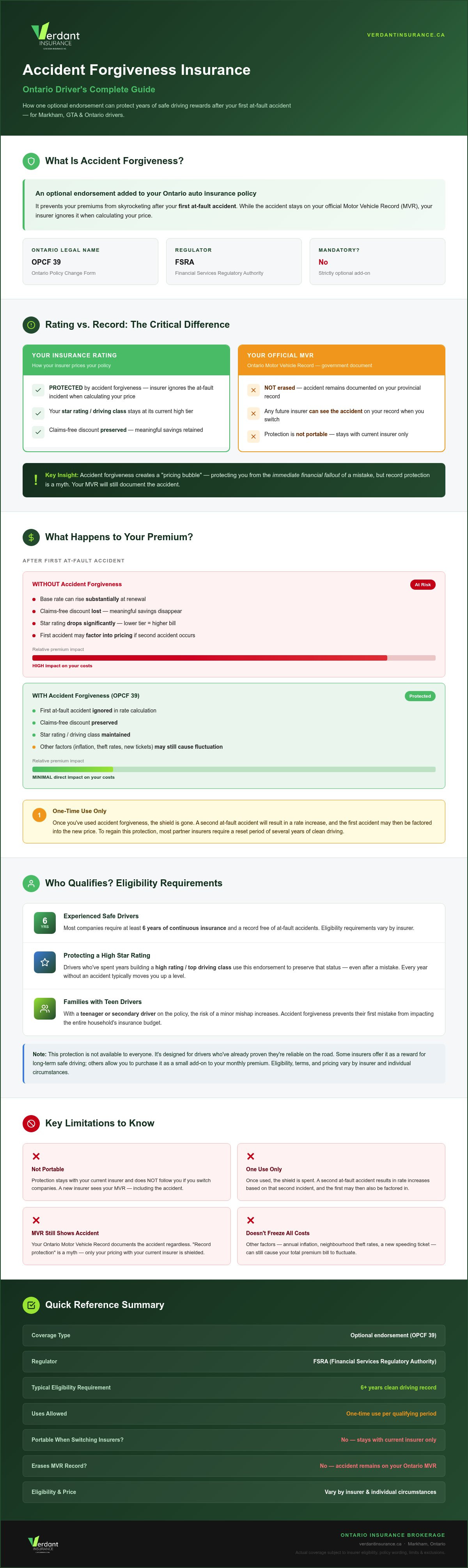
Accident forgiveness insurance Ontario is an optional endorsement you can add to your auto insurance policy. Its primary goal is simple: it stops your premiums from skyrocketing after your first at-fault accident. Think of it as a protective layer that sits between your driving record and your bank account.
While an accident stays on your official record, this endorsement tells the insurance company to ignore that specific incident when calculating your price. It's usually a one-time use protection. Once you've used it to forgive an accident, the shield is gone until you've maintained a clean record for a specific period again. Many insurers offer this as a reward for long-term safe driving, while others allow you to purchase it as a small add-on to your monthly premium.
The Legal Framework in Ontario
In our province, the Financial Services Regulatory Authority (FSRA) oversees all auto insurance rules. This ensures that every driver is treated fairly. Brokers in Markham and the GTA refer to this specific coverage as an OPCF endorsement, which stands for Ontario Policy Change Form. Specifically, it is often referred to as the OPCF 39. While Ontario law requires you to have certain coverages like third-party liability, accident forgiveness is strictly optional. We often recommend it because the cost of a single at-fault accident on your premium can far outweigh the small fee for the endorsement.
Who is This Coverage For?
This protection isn't available to everyone. It's designed for drivers who've already proven they're reliable on the road. Partner insurers typically look for several factors when determining eligibility:
- Experienced Safe Drivers: Most companies require at least 6 years of continuous insurance and a record free of at-fault accidents.
- Policyholders Protecting a Star Rating: If you've spent years building a high rating, this endorsement preserves that status even after a mistake.
- Families with Teen Drivers: If you have a teenager or a secondary driver on your policy, the risk of a minor mishap increases. Having this coverage prevents their first mistake from impacting the entire household's insurance budget.
If you're unsure if you qualify, it's a good idea to speak with a Verdant broker to review your current standing and see which partner insurers offer the most flexible terms for your situation.
How Accident Forgiveness Works: Rating vs. Record
Understanding how accident forgiveness insurance Ontario functions requires looking at two different sets of records. When an at-fault accident occurs, it's documented on your provincial Motor Vehicle Record (MVR). This is a government-managed document that any future insurer can see. Forgiveness doesn't delete this entry. Instead, it changes how your current insurer uses that information to calculate your premium. It essentially creates a pricing bubble that protects you from the immediate financial fallout of a mistake.
Rating protection preserves your price with your current company, while record protection is a myth since your official Ontario Motor Vehicle Record (MVR) will still document the accident.
Most insurance companies use an internal star rating or driving class system to reward long term safe drivers. Every year you drive without an accident, you move up a level, often reaching a high tier status that unlocks lower rates. Without protection, a single at-fault claim could drop your rating significantly, resulting in a much higher bill at renewal. According to Ontario auto insurance regulations, insurers must follow specific rules for how they file these rating plans, and accident forgiveness is one way they offer stability to their loyal clients.
The Impact on Your Premium
An at-fault accident can lead to a substantial rise in your insurance costs. Beyond the base rate hike, you may also lose your claims-free discount, which often provides meaningful savings for safe drivers. While accident forgiveness keeps these specific costs from rising, it doesn't freeze your premium entirely. Other factors like annual inflation, changes in your neighbourhood's theft rates, or a new speeding ticket can still cause your total bill to fluctuate. If you're worried about how a recent incident might affect your costs, you can contact a Verdant broker to review your options.
What Happens After the Second Accident?
It's vital to remember that this protection is typically a one-time use feature. If a second at-fault accident happens while the first is still on your record, the shield is already spent. Your rates will likely increase based on the impact of that second accident, and the first accident may then be factored into the new price. To regain this protection, most partner insurers require a reset period of several years of clean driving. During this time, you'll need to maintain a spotless record to qualify for the endorsement again.
Eligibility and Insurer Rules: A Broker’s Perspective
As a brokerage, we see firsthand that every insurance company has its own playbook. While one company might be quite strict, another might be more lenient with their criteria. This is why understanding accident forgiveness insurance Ontario requires looking beyond a single quote. Most of our partner carriers require at least six years of continuous insurance coverage without any at-fault accidents before they'll offer this protection. However, some go a step further. They may require you to be completely conviction-free, meaning no speeding tickets or other minor infractions on your record for the last three years.
The Financial Services Regulatory Authority of Ontario ensures these rules are filed and approved, but the specific eligibility criteria can still vary significantly between companies. Some high-value policies automatically include this protection as a loyalty reward for long-term clients. For others, it's a small additional cost you can choose to add. At Verdant, we help you weigh these costs against the potential premium spikes you might face without the coverage.
Varying Standards Across Ontario
Location and experience play a big role in what's available to you. A driver in Richmond Hill or Markham might find different eligibility thresholds than someone in a more rural part of the province. There's also a difference between earned forgiveness and purchased endorsements. Some insurers grant it for free after you've been with them for a decade. Others let you buy the endorsement the moment you sign up, provided you have a clean history. Your licence class also matters. Many insurers require a full G licence before they'll offer this specific endorsement, often excluding G2 drivers until they've fully graduated the graduated licensing system.
The Role of an Online Insurance Broker
Finding the right fit doesn't have to be a guessing game. By choosing an online insurance broker in Canada, you gain access to a digital guide that helps you compare these varying rules in real-time. We look at multiple carriers to find the one whose forgiveness rules align with your specific driving history. If you have a minor ticket but a long history of no accidents, we know which insurers are more likely to approve your coverage. Having a professional advocate means you aren't just a policy number. You have a guide to help you understand the fine print before a claim ever happens.
The Limitations: What Accident Forgiveness Does Not Cover
While accident forgiveness insurance Ontario offers a valuable safety net, it isn't a universal eraser for your driving record. It's a specific contractual agreement between you and your current insurance company. The most common misconception is that this protection follows you if you decide to change providers. In reality, this endorsement is non-portable. It only applies to the insurer that issued the policy at the time of the incident. If you leave that company, the "forgiveness" stays behind, but the accident remains on your provincial record.
Another critical boundary is that this coverage only targets at-fault or partially at-fault accidents. If your car is stolen or damaged by a falling tree, these fall under comprehensive coverage. Since comprehensive claims usually don't impact your star rating the same way at-fault accidents do, accident forgiveness isn't used for them. Similarly, this protection does nothing to shield you from rate increases tied to traffic tickets or criminal convictions. A speeding ticket is a conviction, not an accident, and it will be rated accordingly regardless of your endorsement.
The "Switching Trap" in Ontario
If you have an at-fault accident that was forgiven by your current carrier and you decide to shop around for a new policy, you'll likely face a surprise. The new insurer will pull your official Ontario driving record and see the accident listed there. Because they didn't "forgive" that incident, they'll factor it into your new quote. This often makes finding cheap car insurance in Canada much more difficult after an incident. In many cases, staying with your current broker or insurer becomes the most cost-effective path forward until the accident clears your record entirely.
Exclusions and Serious Convictions
No endorsement can protect you from the consequences of major legal infractions. Standard exclusions include racing, stunt driving, or criminal code convictions like impaired driving. If an accident occurs while a driver is committing a serious offence, the forgiveness clause is typically voided. Maintaining a clean conviction record is just as important as protecting against accidents. While we can help you find lenient policies, underwriters view major convictions as a sign of high risk that no "forgiveness" program is designed to cover.
Speak with a Verdant broker about your coverage limits
Securing Your Rates with a Verdant Insurance Broker
Accident forgiveness insurance Ontario serves as a fundamental pillar for any stable insurance strategy. It's the difference between a minor, stressful afternoon and years of inflated premiums. By securing this endorsement, you ensure that your past safe driving habits are respected even when the unexpected occurs. At Verdant, we position ourselves as your proactive guide in Markham and across the GTA, helping you build a policy that prioritizes long term stability over short term fixes.
To see if you're already protected, start by reviewing your current policy declaration page. Look for the endorsement code OPCF 39. If it's not listed, it's a good time to ask why. Sometimes it's a simple add-on you might have missed during a previous renewal, or perhaps your current insurer's eligibility rules were too rigid for your specific history at the time. Reviewing these details before an incident happens is the most effective way to protect your financial future.
Personalized Advice for Ontario Drivers
Our brokers take the time to analyze your unique driving history. We don't just look at your years of experience; we look at the nuances that partner insurers value. This "Friendly Expert" approach allows us to simplify complex policy wording into clear, actionable advice. Whether you're commuting through Richmond Hill or navigating Toronto traffic, we help you find the carrier with the most lenient forgiveness rules for your specific record. We're committed to transparency, ensuring you understand exactly what is covered and, more importantly, what isn't, before you ever need to file a claim.
Next Steps: Get a Quote or Review Your Policy
If you're unsure about your current level of protection, the best step is a professional policy review. You can visit our auto insurance service page to start a customized quote or request a detailed look at your existing coverage. It's important to remember that coverage, pricing, and eligibility always vary based on your individual circumstances and the specific rules of our partner insurers. Achieving peace of mind on Ontario roads starts with having the right advocate in your corner. We invite you to speak with a Verdant broker today to tailor a protection plan that fits your life in the GTA.
Drive with Confidence and Protect Your Star Rating
Protecting your hard-earned safe driving status is one of the smartest moves you can make for your financial well-being. We've explored how accident forgiveness insurance Ontario acts as a vital buffer, keeping your premiums stable even if a mistake happens on the road. It's essential to remember that while this endorsement offers rating protection, it stays with your current insurer and doesn't follow you if you switch companies.
Verdant Insurance is here to help you navigate these rules with ease. Based in Markham, our team provides specialized support for safe drivers across all of Ontario. We offer access to multiple partner insurers, allowing us to find the specific coverage that rewards your clean record. You don't have to guess which policy fits your life. We'll handle the fine print so you can focus on the road ahead.
Speak with a Verdant broker to protect your safe driving record today
Stay safe on the road and enjoy the peace of mind that comes with knowing your rates are secure.
Frequently Asked Questions
Is accident forgiveness mandatory in Ontario?
Accident forgiveness insurance Ontario is not mandatory under provincial law. It's an optional endorsement, often referred to as OPCF 39, that you can choose to add to your auto policy. While standard coverages like third-party liability are required for all drivers, this specific protection is a voluntary add-on designed to provide price stability. Safe drivers often find it's a worthwhile investment to protect their clean record from a first at-fault mishap.
Does accident forgiveness cover my second at-fault accident?
Typically, this protection only applies to your first at-fault or partially at-fault accident. Once you use the endorsement to forgive an incident, the shield is gone. If a second accident occurs while the first is still on your record, your rates will likely increase based on the impact of that second event. You'll usually need several years of clean driving to earn or purchase this protection again for future use.
Can I take my accident forgiveness to another insurance company?
No, accident forgiveness is not portable between different insurers. It's a contractual agreement specific to your current provider. If you decide to switch companies, the new insurer will see the accident on your provincial driving record and will likely factor it into your new quote. This is why staying with your current broker or insurer after a forgiven claim is often the most cost-effective strategy until your record clears.
How long does an accident stay on my driving record in Ontario?
In Ontario, an at-fault accident generally stays on your insurance record for six years. While the Ministry of Transportation might keep records for different durations, insurance companies typically look back at the last six years of your history to determine your rating. After this six-year window passes without further incidents, the accident will no longer impact your premiums, allowing you to qualify for the most competitive safe-driver rates again.
Will my rates still go up if my accident is forgiven?
While accident forgiveness insurance Ontario protects your base rate from increasing after a first claim, your total premium could still fluctuate. Factors like annual inflation, changes in your neighbourhood's risk profile, or a new traffic ticket can still lead to a higher bill at renewal. Forgiveness specifically protects you from the surcharge tied to that first at-fault claim. It doesn't freeze your entire policy price against external market forces.
Do I have to pay extra for accident forgiveness insurance?
Whether you pay extra depends on your insurance company and your driving history. Some partner insurers offer accident forgiveness as a free loyalty reward for drivers who've maintained a clean record for many years. Other companies provide it as a paid endorsement that you can add for a small fee. A broker can help you compare different carriers to see which one offers the best value for your specific history and needs.
Does accident forgiveness protect me from speeding tickets?
No, this endorsement is designed strictly for at-fault accidents and doesn't cover traffic convictions. Speeding tickets, stop sign violations, and other highway traffic act offences are rated separately by insurers. Even if you have accident forgiveness, a new ticket will still impact your conviction-free status and could lead to a rate increase. Maintaining a clean conviction record is just as important as protecting yourself against the financial fallout of a collision.
What is the difference between a forgiven accident and a claims-free discount?
A claims-free discount is a reward for having no history of claims, while accident forgiveness is an endorsement that protects your rating after a claim occurs. If you have an accident and it's forgiven, you might still lose your claims-free discount depending on the insurer's specific rules. The forgiveness endorsement prevents a massive surcharge, but it doesn't always guarantee that you'll keep every single safe-driving incentive you previously earned.