

If you’re wondering why your car insurance went up for no reason in Ontario, the increase may reflect changes beyond your driving record. Insurers can adjust premiums based on claims in your area, vehicle theft risk, repair costs, how you use your car, and changes to your policy or discounts. A parking ticket does not increase your Ontario car insurance premium.
It can feel frustrating to see an increase when you haven’t had an accident or made a claim. But a higher renewal premium doesn’t automatically mean something is wrong with your policy. It may reflect changes in the risks or costs insurers consider.
This article explains common reasons Ontario premiums rise, including more expensive repairs and theft-related costs. You’ll learn what to check when comparing quotes, from your driving and vehicle information to your coverage, deductible, and available discounts. A careful review can help you understand what changed and decide what to do next.
Key Takeaways
- A renewal increase can reflect area-wide claims, theft risk, repair costs or policy changes, even if your driving record is clean.
- Review your vehicle, annual kilometres, commute details and listed drivers for changes that may affect your premium.
- A parking ticket doesn’t increase your Ontario car insurance premium, but traffic tickets and at-fault accidents may affect rates or discounts.
- Compare quotes with the same coverage and deductibles, then review optional coverage and available discounts before deciding.
- Consider how changing a deductible or removing collision or comprehensive coverage could affect your protection as well as your premium.
1. Why did my car insurance premium go up?
Your premium can rise even when your driving record is clean. Insurers consider more than individual accidents and tickets. Claims in your area, vehicle theft risk, repair costs, how far you drive, and changes to your policy can all affect pricing. A renewal increase may reflect these broader factors rather than a new incident involving you. For example, an increase in theft claims near your home can affect how insurers assess risk in the area.
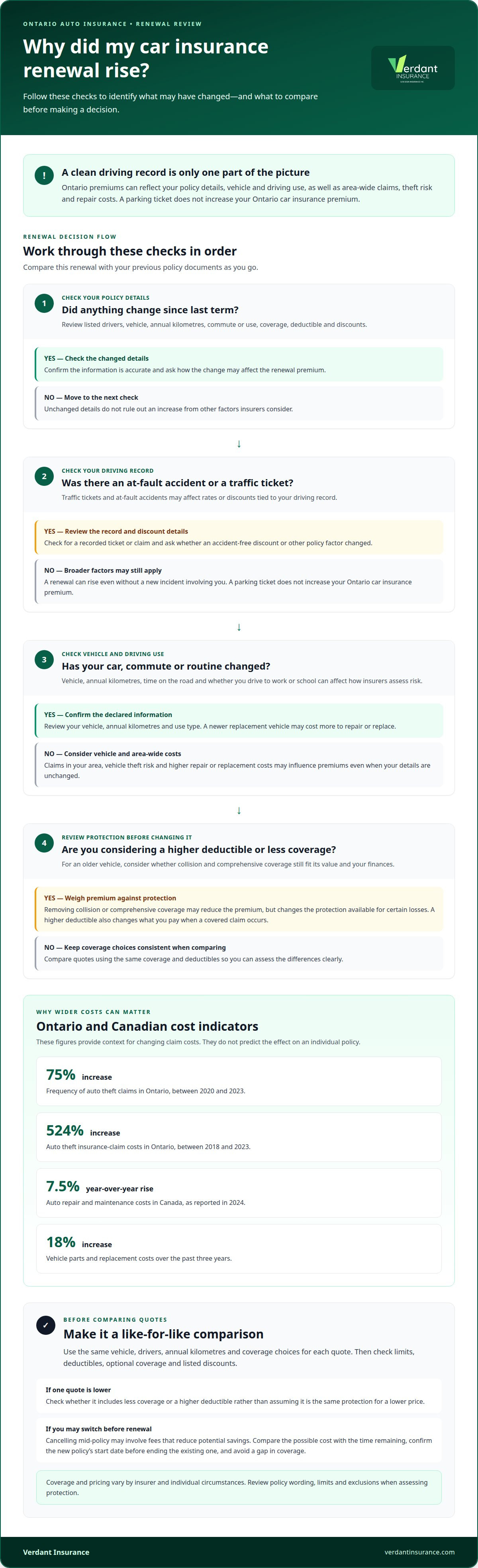
Ontario’s auto theft figures show how local and vehicle-related risks can shift. The frequency of auto theft claims in Ontario increased by 75% between 2020 and 2023. Auto theft insurance-claim costs in Ontario increased 524% between 2018 and 2023. Those rising claim costs can influence premiums, including for drivers who have never reported a theft. If a vehicle is stolen or damaged, insurers may face costs to repair or replace it. Theft risk depends on factors such as the vehicle and where it is insured.
Inflation can also raise the cost of an insurance claim. Canada’s Consumer Price Index reached 8.1% in June 2022. As labour, parts, repairs, and replacement costs rise, settling a claim can become more expensive. Insurers may account for those changing costs when setting premiums. This is one reason a clean record alone can’t prevent every renewal increase. The effect can also vary with your car, location, and how often you drive.
An at-fault accident can affect your premium, even if your earlier driving record was clean. A driver with a clean record may see premiums rise by 30 per cent or more after an at-fault accident. In Canada, investigators deem a driver at fault when they find that driver responsible for 50 per cent or more of a collision. An accident can also affect a discount tied to an accident-free record, adding to the impact at renewal.
Traffic tickets may raise premiums because insurers can view repeated tickets as a sign of increased risk. They may also affect discounts tied to your driving record. Parking tickets may be treated differently from traffic tickets when insurers assess premiums. If your renewal goes up, review your record for traffic tickets or an at-fault claim, then compare your current policy details with last year’s documents.
Start by comparing your renewal with the previous policy term. Check listed drivers, vehicle, use, commute, kilometres, coverage, deductible, and discounts. If these details are unchanged, claims in your area, theft trends, or higher claim costs may help explain the increase. You’ll then have specific points to discuss when reviewing your renewal or comparing quotes.
2. How Do Inflation and Repair Costs Increase Car Insurance Prices?
Rising repair bills can affect insurance rates because insurers pay claims to fix or replace damaged vehicles. Auto repair and maintenance costs in Canada rose 7.5% year-over-year, as reported in 2024. Vehicle parts and replacement costs increased 18% over the past three years. When labour, materials, parts, and replacement vehicles cost more, a collision claim can become more expensive to settle. Insurance companies may account for those higher claim costs when setting premiums.
Parts shortages can add time and expense to repairs. A repair may require several components, and a missing part can delay the work while replacement is sourced. New tariffs on vehicles and parts in 2025 and 2026 are expected to raise repair and replacement costs. Ontario also has an approximate shortage of 2,500 auto technicians. Together, these pressures can affect repair bills, even when your own vehicle hasn’t been in a collision.
Vehicle technology is another factor. Sensors in windshields and cameras in bumpers may need attention after damage, making repairs more involved than replacing an exterior panel alone. These examples show how a vehicle’s model year and design can influence claim costs.
Your location, vehicle, and driving habits also matter. Insurers track claims by area, so drivers in places with more claims may face different rates. A vehicle’s repair and replacement costs can affect its price, while more time on the road means greater exposure to collisions. Premium calculations may also consider annual kilometres and whether you drive to work or school. Review your declared use and distance if your commute or routine has changed.
For an older vehicle, consider whether comprehensive and collision coverage still fit its value and your finances. Removing either may reduce the premium, but it also changes the protection available for certain losses. Don’t compare policies on price alone. Check coverage, deductible, listed vehicle, annual kilometres, and use type side by side. A newer replacement vehicle may cost more to repair or replace, so adding one to a policy can raise the premium. Coverage and pricing depend on the policy and insurer.
3. Comparing quotes and adjusting coverage
Compare more than the total premium. For a useful Ontario comparison, request quotes using the same vehicle, drivers, annual kilometres, and coverage choices. Check each quote’s limits, deductibles, optional coverage, and listed discounts. A lower premium may reflect less coverage or a higher deductible, rather than a like-for-like price. Keep your current policy documents beside each quote to spot differences.
Can you switch car insurance companies before your Ontario policy renewal, and are there cancellation fees? You can change providers before renewal, but cancelling mid-policy may involve fees that reduce any savings. Compare the potential cost of switching with the time remaining on your policy, and confirm the new policy’s start date before ending the existing one. Avoid a gap in coverage.
To check whether your renewal premium was calculated correctly, compare the renewal documents with your previous policy and verify each rating detail. Review the listed drivers, vehicle, address, annual kilometres, commute or other use, coverage, deductibles, and discounts. Correct outdated information, such as a changed commute or vehicle use, and ask an insurance broker to explain any premium change you don’t understand. Ontario drivers can also review available options with a licensed insurance broker.
Coverage choices affect both price and protection. Optional coverage can increase premiums, while reducing or removing coverage changes what the policy may pay for. For an older vehicle, consider its value, your ability to pay for repairs or replacement, and the risks you’d take on yourself. Don’t remove collision or comprehensive coverage solely to lower the quote. Read the policy wording, limits, and exclusions before changing your protection.
Review deductibles side by side. A higher deductible can lower the premium, but you’ll pay more yourself toward a covered claim. Compare the deductible for each coverage instead of assuming one amount applies to every claim. Then check discounts individually. Ontario drivers may qualify for discounts for bundling home and auto, insuring multiple vehicles, low mileage or usage-based plans, or anti-theft devices. Eligibility and discount amounts vary by insurer.
Compare quotes at renewal, not only after an unexpected increase. Cancelling partway through a policy may involve fees that offset a lower premium elsewhere. Before choosing, compare the premium, coverage, deductibles, discounts, and policy dates. Confirm that each quote uses the same driver and vehicle details. This makes it easier to see whether the difference comes from price, coverage, or information entered differently. Supply-chain pressures can affect repair costs, but comparisons should still focus on policy terms and details you can control.
4. Theft risk and vehicle-specific insurance costs
Your car’s insurance cost can reflect theft and claim patterns associated with its model and location. Insurers assess expected losses, so a vehicle that is expensive to replace may be priced differently from one with lower replacement costs. Local claims matter too: theft, collisions, and weather-related damage in your area can influence how risk is assessed, even if you haven’t made a claim.
The scale of theft losses helps explain why this risk can affect premiums. Vehicle theft claims cost insurers a record C$1.5 billion in 2023. Ontario vehicle thefts were down 25.9% compared with the same period in 2024, but a decline in thefts doesn’t erase earlier claim costs or make every vehicle equally low-risk. The model, parts availability, and replacement value remain relevant considerations.
Auto theft creates both replacement and repair risks. If a stolen vehicle isn’t recovered, replacing it can result in a substantial claim. If it is recovered damaged, repairs can add costs. Insurers consider the likelihood and potential expense of claims when pricing coverage. This helps explain why two drivers with similar records can receive different premiums for different vehicles.
If protection against theft matters to you, check whether your policy includes comprehensive coverage. Review the policy wording, limits, deductible, and exclusions to understand what applies to your vehicle. Comprehensive coverage is distinct from collision coverage, which relates to collision losses. Don’t assume every policy handles theft the same way. Protection depends on the insurer’s policy terms and the coverage you select.
Location-based claims extend beyond theft. Weather damage and motor vehicle accidents in an area can affect how insurers assess local risk. An at-fault accident on your record is different from a collision trend across your neighbourhood, but both can be relevant to pricing. Check that your garaging address is accurate, especially after a move within Ontario, because the area associated with your vehicle can affect its rating.
At renewal, compare your vehicle details, location, comprehensive and collision selections, deductibles, and listed discounts. If the premium rose despite an unchanged driving record, ask what changed. Some Ontario drivers may qualify for a theft-related discount for an anti-theft device, but eligibility and terms vary by insurer. Compare quotes using the same vehicle and coverage details to see whether a difference reflects vehicle risk, local claims, or policy choices.
5. Ontario auto insurance rate increases
A renewal increase doesn’t automatically mean your insurer made a mistake. Canadian car insurance premiums increased by nearly 10% over the past five years. In 2025, Ontario had one of the lowest car accident rates among provinces, despite having the highest average auto insurance cost in Canada. These figures show why an individual driver’s clean record may not prevent broader market pressures from affecting a renewal.
How much can an Ontario car insurance premium rise at renewal before you should question it? A sudden 30% increase at renewal is described as something many people experience, but that figure alone doesn’t prove an error. Ask for an explanation of the change, then compare your renewal details with the previous policy. Look for differences in drivers, vehicle, address, coverage, deductibles, and discounts.
Start with your documents. Compare the renewal notice with last year’s declarations and check that each listed driver and vehicle is accurate. Then review your address, annual kilometres, and vehicle use. Note any changes in coverage, deductible, or discount. An updated detail may explain a different rate. If the documents look consistent, ask the insurer or broker to explain the premium calculation and any rating changes.
Separate personal changes from broader rate increases. An at-fault accident, traffic ticket, added driver, or changed commute can affect your individual policy. Frequent claims, theft, repair costs, and other losses across an area can also influence rates. Ask which factors affected your renewal specifically. This can help distinguish a policy detail from a wider change in claims or costs, and give you a clearer basis for comparing quotes.
How do you dispute an auto insurance rate increase or file a complaint in Ontario? First, raise the issue with your insurer and request a clear explanation of the rate change. Keep the renewal notice, previous policy documents, and written responses together. If you believe the increase was unjustified, consumers can file a complaint with the Financial Services Regulatory Authority of Ontario (FSRA). Include the documents showing what changed and the explanation you received.
Before switching, compare equivalent coverage and deductibles at renewal. A quote with different limits or optional coverage won’t show whether another insurer’s rate is genuinely lower for the same protection. Check policy dates too: cancelling mid-policy may involve fees that reduce potential savings. Once you understand the increase, decide whether to correct information, adjust coverage, or compare other terms. Question unexplained differences, but don’t assume every increase is an error.
Verdant Insurance: Auto Insurance
Verdant Insurance can help Ontario drivers review auto insurance options when a renewal increase raises questions. As an insurance brokerage, Verdant can help you consider your vehicle, driving details, coverage choices, deductibles, and the changes shown in your renewal documents. This can make it easier to compare options using consistent details, rather than focusing on the premium alone. Coverage and pricing vary by insurer and individual circumstances, and policy wording, limits, and exclusions apply.
If you’re ready to review your Ontario auto insurance options, contact Verdant Insurance or visit verdantinsurance.com.
Make your next renewal a more informed decision
If you’re still asking why your car insurance went up for no reason in Ontario, turn your renewal into a clear set of questions. Note what you want explained, which policy details matter most to you, and what you’d like to compare before deciding.
A focused review can help you choose your next step with greater confidence. If you’d like support considering your options, Verdant Insurance is available to speak with Ontario drivers.
Take the next step when you’re ready, with a clearer sense of what you need from your policy.
Frequently Asked Questions
Why did my car insurance premium go up?
If you're asking why your car insurance went up for no reason in Ontario, compare this renewal with your previous policy. Check listed drivers, vehicle, address, and coverage for changes. For example, adding a household driver or changing how you use your car can affect the calculation. If those details match, ask your insurer to explain the renewal change and identify which rating factors contributed.
What can you control to lower your premium?
Review the details insurers use to price your policy and correct anything outdated. Confirm your vehicle use, annual kilometres, listed drivers, and address. Then compare quotes with equivalent coverage, limits, and deductibles. Ask which discounts may apply, such as a multi-vehicle or low-mileage option. You can also consider a higher deductible, but weigh the premium difference against what you could pay yourself after a claim.
What causes auto insurance rates to go up in Canada?
Rates can rise when insurers face higher claim costs or reassess risk. Canadian drivers may see changes linked to repairs, parts, vehicle replacement, theft, weather losses, collisions, and claims in their area. Personal details matter too: driving experience, vehicle, location, annual kilometres, and policy choices affect pricing. Compare your policy details and renewal documents to identify which factors may apply to your situation.
Can Filing Multiple Claims Raise Car Insurance Prices Over Time?
Yes, frequent claims can contribute to higher premiums over time. The impact depends on the claim history considered by the insurer and your policy details. Before making a claim for damage, review your deductible and compare it with the repair estimate. If the bill is close to your deductible, you may weigh paying directly against filing a claim. Don’t avoid reporting an incident when your policy or circumstances require it.
How Do Inflation and Repair Costs Increase Car Insurance Prices?
Higher repair costs can increase what insurers pay when vehicles are damaged. Modern cars may need specialized parts or work on sensors and cameras, while shortages can make repairs more difficult. Labour, materials, and replacement vehicle costs also contribute to claim expenses. For your comparison, check that the vehicle on the quote matches its exact model and year, since repair and replacement costs differ.
How Does My Driving History Impact My Car Insurance Rates?
Your driving history can affect how insurers assess risk and whether you qualify for discounts tied to a clean record. An at-fault collision or traffic ticket can change that assessment. The effect depends on the insurer’s rating approach and your full policy details. Insurers also consider driving experience and years licensed. If an incident or conviction appears in your renewal information, ask how it affects the quoted premium and any applicable discount.
What drives premiums to go up?
If you're wondering why your car insurance premium went up for no reason in Ontario, look for changes in your circumstances and broader claims costs. A move, new household driver, different commute, added vehicle, or changed coverage can alter the policy calculation. Claims trends can matter even when your own record is unchanged. Compare policy terms, then ask which specific details contributed to the new premium.
Can Ontario auto insurers raise premiums at renewal without a new ticket or claim?
Yes, a renewal premium can increase without a new ticket or claim on your record. Insurers may account for changes in claims costs and risk patterns, including those connected to your area or vehicle. Review your renewal documents for changes to your information and coverage. If the increase remains unexplained, ask your insurer for the reason. Ontario consumers can also complain to the Financial Services Regulatory Authority of Ontario if they believe an increase was unjustified.


