

Insuring a used car in Ontario starts with arranging coverage before registering it. The law requires third-party liability, accident benefits and uninsured automobile coverage, including at least C$200,000 in third-party liability insurance. Direct Compensation-Property Damage (DCPD) became optional on January 1, 2024, and knowing how to insure a used car in Ontario means understanding which protection is required and which choices affect your own vehicle.
It’s understandable to focus on the purchase price and condition of a used car, then wonder what insurance will add to the cost. This guide explains the required coverage, factors that affect premiums, and how to compare deductibles, discounts and claim forgiveness. You’ll also learn what DCPD does and what to consider before deciding whether to keep it.
With the key terms clear, you can choose coverage that suits the car and how you plan to use it, rather than assuming every used-car policy is the same.
Key Takeaways
- Separate legally required protection from optional collision and comprehensive coverage, then decide how much protection your used car needs.
- Compare discounts carefully: online purchases, claims-free driving and hybrid or electric vehicles don’t automatically qualify for the same savings with every insurer.
- Consider how your vehicle’s repair costs and your driving profile can influence the premium you’re quoted.
- Weigh a deductible against the amount you’d pay out of pocket after a covered claim, and review the terms of any claim forgiveness option.
- Understand what DCPD covers and what changing it could mean for damage to your vehicle.
What car insurance coverage is mandatory in Ontario?
Mandatory auto insurance is the protection Ontario requires for vehicles driven on its roads. It includes third-party liability, accident benefits and uninsured automobile coverage; liability insurance must provide at least C$200,000. Since July 1, 2026, some accident benefits are optional, but standard medical, rehabilitation and attendant care benefits remain mandatory.
Collision coverage helps pay for damage to your own vehicle after a collision, including an at-fault accident. Comprehensive coverage applies to specified non-collision losses, such as theft or certain weather damage, subject to the policy wording. Ontario law does not require either coverage, but both can help with repairs if your used car is damaged.
OPCF27 is an endorsement that extends liability and accident benefits coverage to certain non-owned vehicles. It applies to personal-use vehicles weighing less than 4,500 kilograms and rentals for up to 30 days at a time.
Non-owner car insurance provides liability protection when you drive a vehicle you don’t own, but not collision or comprehensive coverage. In Ontario, it isn’t sold as an independent policy; OPCF27 may provide related protection through an existing policy.
A used car bought from a dealer does not automatically cost more or less to insure than one bought privately. Quotes depend on the vehicle and applicant’s details. Compare quotes using the same vehicle information and coverage choices.
Before requesting a quote, gather the vehicle identification details, driver information and purchase details. Insurers need enough information to identify the car and assess the proposed policy. The exact details requested vary by insurer.
A safety standards certificate is separate from an insurance policy. Whether you need one for registration depends on the vehicle’s registration circumstances, and it does not replace insurance coverage.
You can arrange insurance before registering a used car. In Ontario, you must buy insurance before registering the vehicle as its owner. Buyers who purchase privately register the car themselves.
If you buy privately, arrange coverage for the car before driving it. The seller’s policy does not become yours when ownership changes.
Driving without the required insurance is unlawful and can have legal and financial consequences. Keep the vehicle’s liability insurance card with you when driving.
To arrange a policy, provide the vehicle and driver details, select coverage and pay the first premium. The policy takes effect according to its terms after you select coverage and make the payment.
If you’re transferring existing insurance, contact your insurer to update the policy with the used car and confirm its effective date before driving. Do not assume there is an automatic transfer period. Coverage begins on the effective date stated in the updated policy.
Discounts for online purchases, claims-free driving, and hybrid or electric vehicles
Discounts can affect the premium quoted for a used car, but a discount offer alone does not show the policy’s total value. Compare the coverage, eligibility rules and final premium before choosing.
Online and Vehicle-Type Discounts
An online-purchase discount is a premium reduction an insurer may offer when you buy a policy online. A hybrid or electric vehicle discount is associated with insuring that type of vehicle. These are separate discount categories, and neither applies automatically.
For an online quote, enter the same driver and vehicle details you would provide to an insurance representative. Compare the premium and coverage with other options. A lower quote is useful only if its coverage, limits and deductibles also suit your needs.
For a used hybrid or electric car, provide its correct make, model and vehicle identification details. Don’t assume its powertrain guarantees a discount. Insurers use their own pricing and eligibility criteria to assess the vehicle and policy. Compare the complete quote, not just the discount label.
Claims-Free and Safe-Driving Discounts
A claims-free discount is a premium reduction linked to a driver’s claims history. A safe-driving discount recognizes driving behaviour or record under an insurer’s rules. Availability and terms depend on the insurer, policy and driver’s circumstances.
Usage-based insurance uses driving information collected through a telematics program to determine pricing. Before enrolling, understand what information the program collects, how it assesses driving and how the results affect your premium. Review the program’s terms, since telematics options do not all work the same way.
Keep your driving and claims information accurate when requesting a quote. If more than one person uses the car, include the relevant driver details rather than providing only the primary driver’s record. Claims-free history and safe-driving records are distinct factors, so ask how each applies to the quoted policy.
Ontario drivers must carry the liability insurance card for the vehicle they’re driving, whether they own it or have borrowed it. Keep the current card available in the vehicle. A discount does not replace proof of insurance or change the coverage shown on the card.
Factors that affect Ontario car insurance premiums
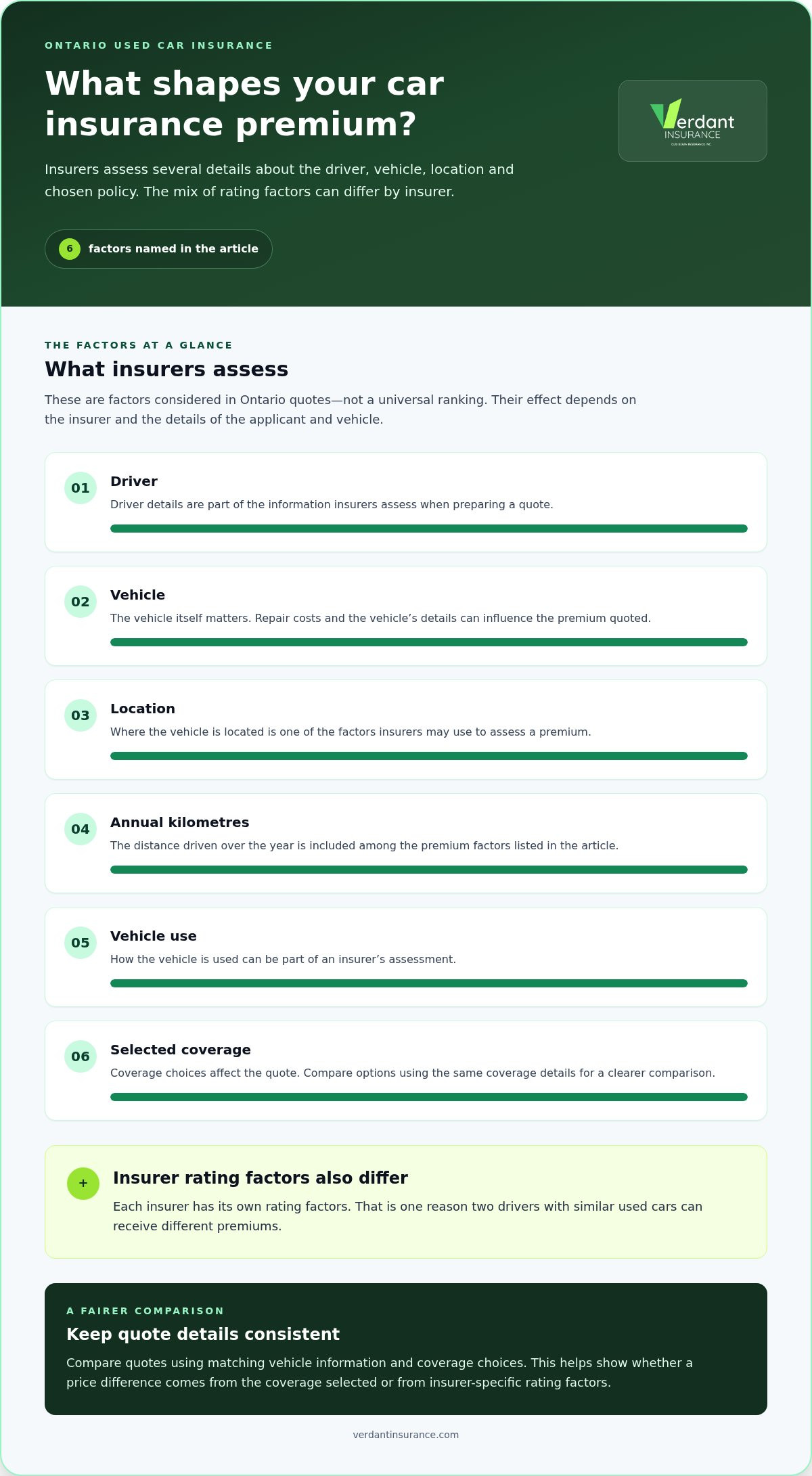
A premium is the amount charged for an insurance policy. In Ontario, insurers assess factors such as the driver, vehicle, location, annual kilometres, vehicle use and selected coverage. Each insurer’s rating factors also affect the quote. As a result, two drivers with similar used cars can receive different premiums. Compare quotes using matching details to see whether a price difference comes from coverage choices or the insurer’s assessment.
A driver’s experience, driving record and claims history can influence the premium. For instance, a driver with a recent claim may receive a different quote from someone with a claims-free history. Include everyone who regularly uses the car when requesting a quote. Leaving out a regular driver makes the information inaccurate and may affect how the insurer assesses the application.
The vehicle matters, too. Cars that cost less to repair may cost less to insure, but repair costs vary with the make, model, parts and work involved. A used car with a lower purchase price may still cost more to insure if repairs are expensive. If you’re deciding how to insure a used car in Ontario, request quotes for the specific vehicle before committing to buy it.
Location and vehicle use help insurers assess how a car is driven. Provide the address where it’s kept, its expected annual kilometres and whether you’ll use it for commuting or personal trips. A car used for a daily commute, for example, has a different use profile from one driven occasionally for errands. Describe your planned use accurately when comparing quotes.
Coverage choices affect both the price and the protection provided. Liability coverage responds to eligible claims involving injury or property damage to others. Optional collision and comprehensive coverage can add protection for damage to your own car, subject to the policy terms. Compare quotes with the same coverages and limits to assess them on an equivalent basis.
The deductible is another key comparison point. It is the amount you pay toward a covered loss before the insurer contributes, subject to the policy. Consider the deductible alongside the premium and whether you could manage that out-of-pocket cost after a claim. A lower premium may come with different coverage or deductible terms, so check both before choosing.
Rental-related options and policy exclusions can also affect what a quote includes. Read the policy wording to understand what is covered and what is excluded. For a practical comparison, list each insurer’s premium, limits, deductibles and relevant exclusions side by side. Knowing how to insure a used car in Ontario means comparing policy details, not just the amount in the quote.
Deductibles and claim forgiveness
For an Ontario driver, the deductible becomes especially important when a covered claim leads to repairs. Consider how you would handle a repair estimate, the insurer’s assessment and any amount the policy assigns to you. Thinking through that situation can make the deductible choice clearer than reviewing a policy summary alone.
For example, if a repair estimate is close to your collision deductible, the amount payable under that coverage may be limited. If the damage is more extensive, the deductible still affects your share. The final claim assessment depends on the policy wording, coverage limits and circumstances of the loss, not only the repair shop’s initial estimate.
Before choosing a deductible, consider the repair costs you could manage without disrupting other expenses. Someone who relies on a used car to commute may approach the decision differently from someone with another way to travel. Think about your budget and vehicle needs, then check the deductible for each applicable coverage in the policy documents.
Claim forgiveness is a policy feature that can protect an eligible driver’s premium rating after a qualifying at-fault claim. The policy sets out its terms. It does not mean the collision did not happen, erase the claim from your insurance record or guarantee that every consequence disappears.
Read the claim-forgiveness wording before relying on the feature. Find out which claims qualify, whose driving it applies to and whether the policy sets conditions for keeping it. Also understand how the insurer treats the feature if you change vehicles or renew. Do not assume another insurer offers the same terms.
After an accident, record the date, location and circumstances, and keep relevant photographs, estimates and repair documents. Report the incident through your insurer’s process and ask how the deductible and any claim-forgiveness feature apply. Keep written claim communications with your Ontario policy documents so you can refer to the insurer’s assessment and stated terms.
At renewal, review any claim-related changes alongside the policy wording. Ask for a clear explanation of how an at-fault claim affects your record and whether forgiveness applies. Ontario policies have their own terms, so the feature’s name alone does not explain its conditions or effect.
Direct Compensation-Property Damage (DCPD)
Direct Compensation-Property Damage (DCPD) is Ontario auto insurance coverage for eligible damage to your vehicle. It may apply after an accident involving another vehicle, depending on the circumstances and policy wording. For a used-car owner, the practical question is how this protection fits with the other coverage selected.
DCPD is distinct from collision coverage, although both can relate to damage to your own car. Their terms and the circumstances in which they apply differ. Review the policy wording rather than assuming one coverage replaces the other. A repair estimate alone also does not determine whether a loss qualifies under DCPD.
Ontario policyholders can ask to remove DCPD, but removal happens only at the policyholder’s request by speaking with an insurance advisor. Before requesting the change, ask how it affects the policy and when the revised terms would apply. Read any policy documents describing the change, then keep them with your current insurance records.
Consider the decision in light of the car you own and how you would manage damage-related expenses. For example, someone who depends on a used car for work may weigh reduced protection differently from someone with another way to travel. These are personal considerations, not a substitute for understanding the coverage in your policy.
Review these details before deciding:
- Check the policy: Find whether DCPD is included and read its applicable terms.
- Consider your vehicle: Think through how damage could affect your ability to use the car and manage repairs.
- Understand related coverage: Compare DCPD with collision coverage without assuming they respond in the same situations.
- Request a change deliberately: If you want DCPD removed, speak with an insurance advisor and review the updated policy documents.
The circumstances of an accident and the policy wording determine how a DCPD claim is assessed. Keep relevant claim documents together, including repair information and communications about the insurer’s decision. This record can help you understand how the policy applied to your loss.
When insuring a used car in Ontario, assess DCPD as one part of your overall coverage decision. Consider what protection would remain if you removed it and whether that suits your needs. The policy’s terms, limits and exclusions explain the protection in force, so base your decision on those documents rather than the coverage name alone.
Verdant Insurance: Auto Insurance
Verdant Insurance is an Ontario insurance brokerage that helps drivers explore Auto Insurance for a used vehicle. If you’re comparing required coverage with optional protection, a broker can help you consider your vehicle, how you use it and the coverage choices you’re weighing. Policy terms, eligibility and premiums vary by insurer and individual circumstances, so review the details before choosing. Verdant offers customizable policies and online quote and policy management options, supported by dedicated assistance. This can be a useful next step if you want help making sense of coverage choices or arranging a policy for a used car. Contact Verdant Insurance to discuss your Ontario auto insurance needs.
Make your next insurance decision with confidence
Before choosing a policy, consider how you’ll use the car and what out-of-pocket expense you could manage. That context helps keep comparisons focused on protection that fits your circumstances, not just a discount or premium.
Knowing how to insure a used car in Ontario also means identifying the questions that matter to you. Write down anything you want clarified about policy wording, exclusions or how a change in vehicle use could affect coverage. Bring those questions to your insurance conversation.
Verdant Insurance offers Auto Insurance, Homeowner Insurance and Business Insurance. Coverage options and premiums depend on the insurer and your circumstances.
A thoughtful choice starts with clear priorities. Take the next step when you’re ready.
Frequently Asked Questions
How is the cost of car insurance calculated in Ontario?
An insurer uses its rating process to turn application details into a premium. The amount is not a fixed charge tied to the car’s purchase price. Before accepting a quote, review the information used to calculate it, including the listed drivers and intended vehicle use. If you find an error, have it corrected so the policy reflects your circumstances.
At-Fault vs No-Fault insurance, what’s the difference?
At-fault refers to responsibility for a collision; no-fault describes how eligible claims are handled through a driver’s own insurer. The terms are not opposites: a driver can be considered at fault and still deal with their insurer under Ontario’s system. Fault can affect claim assessments and a driver’s record, but it does not mean every collision automatically changes a premium.
Can I drive a vehicle that is not insured under my name?
Yes, an owner can lend an insured car to another driver, and the owner’s policy may respond to eligible claims. Get the owner’s permission and make sure the insurance card is current and for that vehicle. If you’ll use the car regularly, tell the owner so the insurer can assess the arrangement. A brief loan and regular use may be treated differently under the policy terms.
Can you insure a car in someone else’s name in Ontario?
The policy information should match the vehicle’s registered ownership. If the car is leased or financed, the person buying the policy must be named as the registered owner or appear on the leasing or loan documents. Don’t put the car in someone else’s name just to obtain insurance. Accurately describe the ownership arrangement and who will drive when you apply.
Do some vehicles cost less to insure than others?
Yes, insurers can assess different vehicles differently. Before buying, request a quote using the exact make, model and vehicle identification details. A general estimate for a model range may not reflect the specific car. Trim, equipment and vehicle history can distinguish cars that otherwise look similar. A quote before purchase helps you factor insurance into your decision.
How can I get the best car insurance rate?
Choose a quote that fits your needs rather than assuming the lowest figure is best. Compare options using the same information and review the policy details before deciding. If your household also insures a primary residence, placing auto and property insurance with the same insurer may qualify for a multi-policy discount. Eligibility and discount amounts vary by insurer.
How do I get an auto insurance quote online?
Complete an online quote request with accurate driver, vehicle and ownership details. Include the vehicle identification information and describe how you’ll use the car. Before submitting, review your entries, especially the registered owner and regular drivers. Verdant’s insurance brokers review quote requests and compare available options. Treat a quote as an estimate until the insurer confirms the policy terms.
How does automobile insurance work in Ontario?
You buy a policy from a private insurer, and its contract describes the protection, conditions and exclusions that apply. If an incident occurs, report it through the insurer’s claims process and provide relevant details, such as the date, location and people involved. The insurer assesses the claim against the policy and circumstances. Keep policy documents and claim correspondence together for future reference.


