

A rental car can involve more than the damage waiver offered at the counter. For Ontario drivers, the OPCF 27 endorsement explained here is an optional auto policy endorsement for liability for damage to non-owned vehicles. It can cover eligible rented or borrowed vehicles in Canada and the United States, with physical damage coverage typically capped at $50,000, subject to the policy’s terms.
It’s reasonable to wonder whether your own auto insurance follows you into a rental. OPCF 27 may extend certain coverages from your policy, but it doesn’t apply to every vehicle, driver, use or trip. Knowing those limits can help you understand what protection you already have and where a gap may remain.
This guide explains what OPCF 27 covers, how it applies to rental cars, and which exclusions matter. You’ll also learn what can affect its cost and how to discuss adding it to an Ontario auto policy. The goal is a clearer picture of how this endorsement fits alongside other policy options, so you can make a more informed decision before you need to drive a vehicle you don’t own.
Key Takeaways
- OPCF 27 is an optional endorsement that may extend parts of your auto coverage to eligible rental or borrowed vehicles.
- Its protection can include liability, accident benefits and physical damage, but limits and deductibles matter.
- Rental location, length of use, vehicle type and how it’s used can affect whether the endorsement applies.
- Review your policy and discuss your driving needs with an Ontario auto insurance broker to understand whether adding it makes sense.
Does OPCF 27 count as rental car insurance?
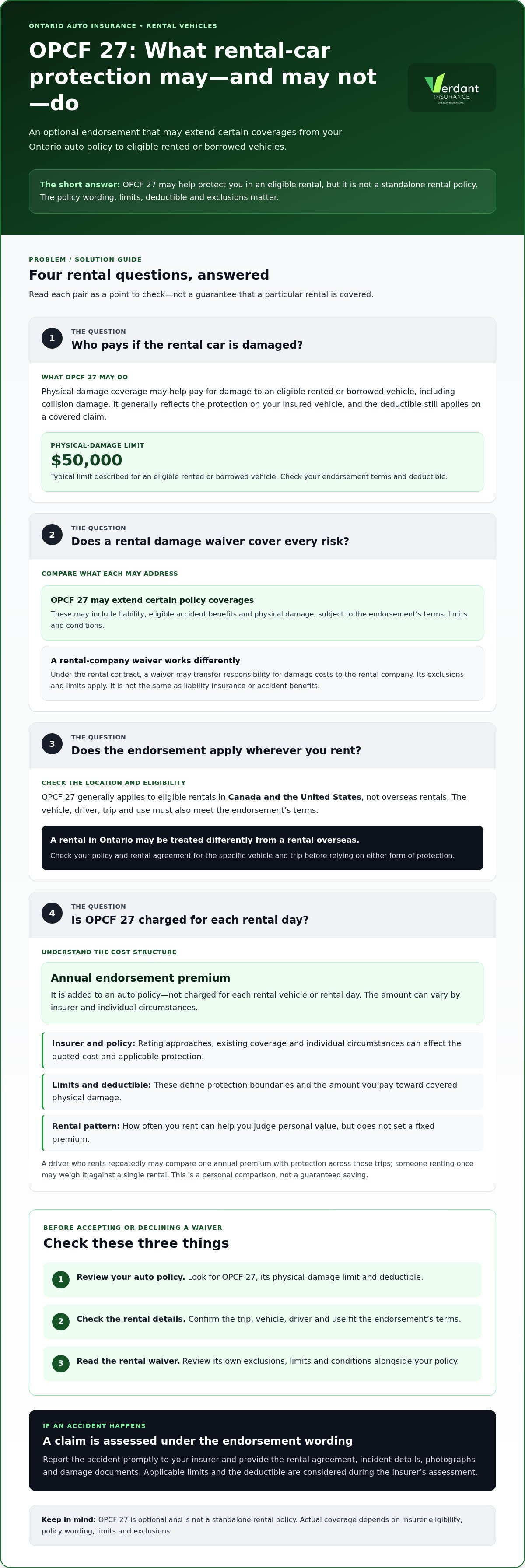
Yes, OPCF 27 can provide insurance protection for eligible rental cars, but it isn’t a standalone rental policy. Ontario’s optional endorsement, formally titled “Liability for Damage to Non-Owned Automobile(s),” may extend certain coverages from your auto policy to a rented or borrowed vehicle. Its terms, limits and exclusions determine how that protection works.
Three types of coverage may matter after an accident. Liability coverage may apply if you’re legally responsible for injury or property damage to someone else. Accident benefits may respond to eligible injuries under the applicable policy. Physical damage coverage may help pay for damage to the rental vehicle, including collision damage, subject to the endorsement’s terms and deductible. These protections can have different limits and conditions.
For physical damage, OPCF 27 typically provides coverage up to a $50,000 limit for an eligible rented or borrowed vehicle. The coverage generally reflects the protection on your insured vehicle, rather than automatically providing every protection available from a rental company. For example, a driver whose policy covers collision damage may have that type of protection extended to an eligible rental. The deductible still matters: you may be responsible for that amount on a covered claim.
Rental-counter collision damage waivers work differently. Under the rental company’s contract, a waiver may transfer responsibility for damage costs from you to the rental company. Exclusions or limits can affect what the waiver covers. It is not the same as liability insurance or accident benefits.
Cost is another difference. OPCF 27 is an endorsement on an auto policy, not a daily counter purchase, so compare the policy premium and conditions with the rental agreement’s waiver terms.
Before accepting or declining a waiver, take these steps:
- Review your auto policy for OPCF 27 and its physical damage limit and deductible.
- Check whether your trip and rental vehicle meet the endorsement’s terms.
- Read the rental company’s waiver terms, including exclusions and limits.
OPCF 27 generally applies to eligible rentals in Canada and the United States, not overseas rentals. A rental in Ontario may therefore be treated differently from one in Europe. The endorsement can be a useful part of rental-car protection, but the rental agreement and your own policy cover different risks. Compare both documents before deciding what protection to rely on.
Factors affecting the endorsement's cost
That’s an annual endorsement premium, not a charge for each rental vehicle or rental day. The amount on an individual policy can vary by insurer and personal circumstances. Treat the range as a general guide, not a quote for a specific automobile or driver.
The insurer sets the premium based on its rating approach and your policy details. The endorsement extends certain coverages from an insured auto policy to eligible non-owned vehicles. Your existing coverage, applicable limits and deductible help define the protection. Ask for the cost alongside those details so you can compare the premium and terms together.
- Insurer: Different insurers can price OPCF 27 differently.
- Driver and policy: Individual circumstances and the existing auto policy affect the quoted cost and applicable coverage.
- Limits and deductible: These determine the boundaries of protection and the amount the insured pays toward covered physical damage.
- Rental pattern: How often you rent helps you judge the endorsement’s value, but doesn’t establish a fixed premium.
For example, a driver who rents repeatedly can compare one annual premium with the protection needed across those trips. Someone renting once may weigh the same annual cost against a single rental. That comparison is about personal value, not a guaranteed saving. Rental duration, vehicle eligibility and use can also determine whether OPCF 27 applies to a particular rental.
To understand the cost of adding OPCF 27, request the endorsement premium as a separate line on the Ontario auto policy quote. Compare the quoted amount with the policy’s physical damage coverage, limit and deductible. Also check whether the named drivers and expected rental use fit the wording. An Ontario Policy Change Form records an endorsement, while the policy documents explain its terms.
How do you make a claim under OPCF 27 in Ontario? Report the accident promptly to your insurer and provide the rental agreement, incident details, photographs and damage documents. The insurer assesses the claim under the endorsement wording, applicable limits and deductible.
Before adding the endorsement, consider how often you rent vehicles, the coverage already included in your policy and the quoted annual premium. These details can help you decide whether the added protection suits your driving needs. The insurer’s policy wording governs coverage and claim assessments.
What is an OPCF 27 endorsement?
OPCF 27 is an optional endorsement attached to an Ontario auto insurance policy. “OPCF” stands for Ontario Policy Change Form. Ontario auto insurance endorsements are documented using Ontario Policy Change Forms, or OPCFs. The number 27 identifies this particular form and its terms. It’s not a separate auto policy or a rental agreement from a vehicle provider. In Ontario, the endorsement changes how the policy applies to specified situations.
An endorsement changes how a base policy works. The base policy sets out the insured vehicle’s coverages, limits, conditions and exclusions. An endorsement adds, changes or removes specific terms for the risks it addresses. For example, OPCF 27 addresses legal liability for damage to a non-owned automobile. The policy and endorsement wording work together to define coverage.
The form matters because a general policy summary may not show every condition attached to a change. An Ontario driver reviewing OPCF 27 should read the endorsement alongside the policy, not as a replacement for it. That helps connect the form’s conditions with the underlying coverage, deductible and limits. A broker can explain how the wording relates to the policyholder’s circumstances.
Think of an Ontario Policy Change Form as a precise adjustment, rather than a rewrite of every policy term. For instance, adding OPCF 27 changes the policy’s treatment of certain non-owned automobiles. It doesn’t automatically make every borrowed vehicle or rental arrangement eligible. The endorsement’s own wording sets its scope, while the base policy remains relevant.
When examining an OPCF 27 document, focus on these details:
- Named insured: Identify the person or people whose policy includes the endorsement.
- Covered situation: Read the wording about damage to non-owned automobiles and how the vehicle is used.
- Limits and deductible: Note the financial boundaries and the insured’s share of a covered loss.
- Conditions and exclusions: Look for circumstances that restrict or prevent the endorsement from applying.
For example, one policyholder may borrow a vehicle from someone in their household, while another rents a car for a trip. The form may treat these situations differently. Calling a vehicle “borrowed” doesn’t determine whether coverage applies. Ownership, use, the driver and the policy wording all matter.
OPCF 27 is one member of Ontario’s broader group of numbered auto insurance endorsements. Each Ontario Policy Change Form addresses particular policy terms, so one form cannot be treated as a substitute for another. Read the endorsement number and title on your documents, then compare its wording with the base policy before driving or renting an automobile.
Endorsement eligibility and limitations
OPCF 27 may apply beyond Ontario, but its geographic reach has boundaries. Eligible rentals in Canada and the United States can fall within its scope; rentals in Mexico, Europe and the Caribbean don’t. A driver planning a trip outside Ontario should distinguish travel within Canada or the United States from overseas rental use.
Driver eligibility matters, too. OPCF 27 generally applies only to drivers listed on the auto policy. It doesn’t extend liability coverage to a driver excluded under OPCF 28A. For example, a listed policyholder and an excluded household driver don’t have the same status under the endorsement. Read the policy’s driver details before lending a rental vehicle to another person.
The vehicle’s relationship to the insured can also affect eligibility. OPCF 27 doesn’t cover vehicles owned or leased by the policyholder, a household member or their employer. It also excludes vehicles routinely borrowed by those people. That distinction separates a qualifying temporary rental from regular access to a vehicle that effectively forms part of someone’s usual driving arrangements.
Rental duration has a specific boundary. Non-owned vehicle rental contracts lasting more than 30 days aren’t covered under OPCF 27, including during the first 30 days of that contract. A driver can’t assume the initial weeks qualify simply because the rental agreement later exceeds the limit. The contract’s total duration matters, so review it before accepting a long-term rental.
Use is another important limit. The endorsement excludes vehicles used for commercial purposes, including sales, deliveries, storage, repairs or transporting passengers for compensation. A personal rental for a vacation differs from an automobile used to make paid deliveries. A vehicle with a gross vehicle weight rating over 4,500 kg is also generally outside the endorsement’s expected eligibility.
Before relying on OPCF 27 for a rental, compare these details with your policy and rental agreement:
- Driver: Confirm the person driving is listed and isn’t excluded under OPCF 28A.
- Vehicle: Check ownership, regular access and gross vehicle weight rating.
- Use: Identify whether the rental involves business activity or paid passenger transport.
- Term and location: Review the full rental period and where the vehicle will be driven.
These limits show why the endorsement’s title, “Liability for Damage to Non-Owned Automobile(s),” doesn’t mean every non-owned automobile qualifies. The policy wording defines the covered situation. A rental in Canada may meet the location requirement, for instance, yet fall outside eligibility because its contract exceeds 30 days or its use involves paid deliveries.
Adding endorsements to an Ontario auto insurance policy
OPCF 27 is optional in Ontario, so adding it starts with identifying your driving needs. Consider whether you rent or borrow vehicles, who drives them, and how you use them. Then compare those details with your existing insurance policy and the endorsement’s wording. An Ontario auto policy can have different endorsements for each insured vehicle, so don’t assume one vehicle’s selections apply to every car.
Ask your broker to explain how a proposed endorsement changes the base policy, including its limits, deductible, exclusions and premium. For OPCF 27, discuss whether the non-owned vehicles you expect to drive fit the terms. The named drivers, rental duration, vehicle and use can all matter. Review the policy documents after the change to confirm which vehicle has the endorsement and what terms apply.
Other Ontario Policy Change Forms address different needs. They aren’t interchangeable. For example:
- OPCF 20 provides transportation replacement coverage, also called Loss of Use, while a vehicle is repaired or replaced after a covered claim.
- OPCF 44R is optional Family Protection Coverage. It can increase protection up to your policy limits when an at-fault driver has insufficient insurance.
- OPCF 43 is a limited waiver of depreciation for a new vehicle stolen or written off in a covered claim.
- OPCF 49 lets an Ontario driver decline coverage for collision damage to their own vehicle.
Choose based on the risk you’re addressing, not the form number alone. A rental car concern points toward reviewing OPCF 27; a damaged insured vehicle and transportation needs may make OPCF 20 relevant. If an at-fault driver lacks enough insurance, OPCF 44R addresses a different gap. Each form has its own conditions, and your policy documents show which endorsements apply.
For a clear review, gather your current auto insurance policy and identify the vehicle you want to insure. Note who drives it, whether you rent or borrow other vehicles, and what protection you’re considering. Ask for the endorsement name, the vehicle it applies to, its limits, deductible and premium. Compare the updated documents with your previous policy before relying on the change.
Ontario car insurance endorsements can also address leasing, business use or accident forgiveness. OPCF 5 permits insurance to be transferred to a leasing or rental company. OPCF 27B is designed for business use and addresses liability for damage to non-owned automobiles in your care, custody or control. OPCF 39 is designed to protect against a premium increase after a first at-fault or partially at-fault accident. These forms serve distinct purposes.
If you’re reviewing endorsement options for your policy, discuss your Ontario auto insurance needs with Verdant Insurance.
Verdant Insurance: Auto Insurance
Verdant Insurance can help Ontario drivers review their auto insurance needs, including whether rental or borrowed vehicle use makes OPCF 27 worth discussing. As a brokerage, Verdant can explain how an endorsement fits alongside your policy’s limits, deductibles and exclusions, and help you understand the options available for your circumstances. The right questions include who drives the vehicle, how often you rent, and whether the rental’s terms match the endorsement wording.
If you’re reviewing your policy or considering a change, contact Verdant Insurance to discuss your Ontario auto insurance needs.
Make your next policy review more useful
Use your next policy review to connect insurance choices with how you actually drive. An explanation of the OPCF 27 endorsement in Ontario can be a starting point, but your priorities may also include other parts of your coverage. Whether adding an endorsement makes sense depends on your circumstances and the policy terms.
Verdant Insurance offers Auto Insurance, Homeowner Insurance and Business Insurance. If you’re reviewing your Ontario auto policy, contact Verdant Insurance to discuss your coverage and the options relevant to your needs.
A thoughtful review can make your next insurance decision clearer. Ask questions and choose an option that fits your needs.
Frequently Asked Questions
What is OPCF 27 coverage in auto insurance?
OPCF 27 adds protection for an insured driver’s legal liability for damage to certain non-owned vehicles. In practical terms, it can be relevant when you rent an automobile for a personal trip or borrow an eligible vehicle. The endorsement works alongside your Ontario auto policy, so the policy’s limits, deductible and conditions shape how it responds to a covered loss.
How much does it cost to add OPCF 27?
The actual premium depends on the insurer and your circumstances, including your policy and coverage terms. Ask for the endorsement’s annual premium separately from the rest of your auto insurance cost. Then compare it with the limits and deductible, rather than judging the price without considering the protection it provides.
Is OPCF 27 mandatory?
No. OPCF 27 is optional in Ontario, unlike the minimum auto insurance required by law. Drivers who only use their own insured vehicle may have little reason to add protection for non-owned automobiles. Someone who rents vehicles for personal travel may have a different need. Consider your driving habits and policy details before deciding whether this optional endorsement belongs on your policy.
Are there any requirements for OPCF 27 that drivers should know about?
Yes. The driver generally needs to be listed on the policy, and the rental must meet the endorsement’s vehicle, use and duration conditions. For example, a rental contract longer than 30 days is outside the stated coverage, including its initial 30 days. Commercial use, such as paid deliveries, is excluded. Review the policy wording before a rental, especially if another person will drive.
Are there other ways to insure a rented or borrowed vehicle in Ontario?
Yes. A rental company may offer a collision damage waiver, which shifts responsibility for covered vehicle damage under its contract. Some credit cards also include rental-car coverage as a card benefit. Terms differ: credit-card coverage may end after 31 to 48 consecutive rental days, and many cards restrict eligible vehicle value. Compare the card terms, rental agreement and personal auto policy before relying on one source.
Do you need OPCF 27 in Ontario?
Not every Ontario driver needs this endorsement. If you drive only your own vehicle, it may not address a regular need. If you often rent or borrow eligible vehicles, compare its annual premium with your rental patterns and other protection. For instance, if you borrow a friend’s car for a weekend, consider the policy’s conditions for drivers and vehicles.
How does OPCF 27 work if you get in an accident?
After an accident involving an eligible rental or borrowed vehicle, report it to your insurer and follow its claims instructions. Keep the rental agreement and records of the incident, then provide requested details about the damage and drivers. The insurer assesses liability and damage under the policy wording, limits and deductible. The endorsement doesn’t remove your responsibility to follow the rental contract’s reporting requirements.
What is OPCF 27 in Ontario auto insurance?
OPCF 27 is Ontario’s optional “Liability for Damage to Non-Owned Automobile(s)” endorsement, also known as the rental vehicle insurance endorsement. OPCF means Ontario Policy Change Form. It modifies an auto policy for specified non-owned vehicle situations rather than creating a separate policy. For example, an eligible rental may fall within its scope, while a vehicle used for paid passenger transport does not.


