

The same vehicle may need personal or commercial coverage depending on how it is used. A vehicle used for business deliveries, carrying goods or equipment, or transporting customers may require commercial auto insurance. Commercial vehicles operating on Ontario public roads must be insured. A commercial auto insurance quote in Ontario reflects factors such as vehicle use, drivers, and selected coverage.
It’s understandable to focus on the premium when comparing quotes, but the details behind each one matter too. A lower price may reflect different limits, deductibles, or protection for how your business vehicle is used.
This guide explains what may qualify as a business vehicle, what commercial auto coverage may include, and which factors affect premiums. You’ll also learn how to compare Ontario quotes and assess discounts, so you can make a more informed choice for your business.
Key Takeaways
- Review how your vehicle is used and who drives it to understand what kind of business coverage may fit.
- Compare the protections and limits in each quote, not just the premium.
- See how driver history, vehicle details, deductibles, and coverage choices can affect cost.
- Explore how discount eligibility and bundling may influence your options, as terms vary by insurer.
- Use a consistent checklist to compare Ontario quotes and spot differences that matter to your business.
What is a commercial or business vehicle?
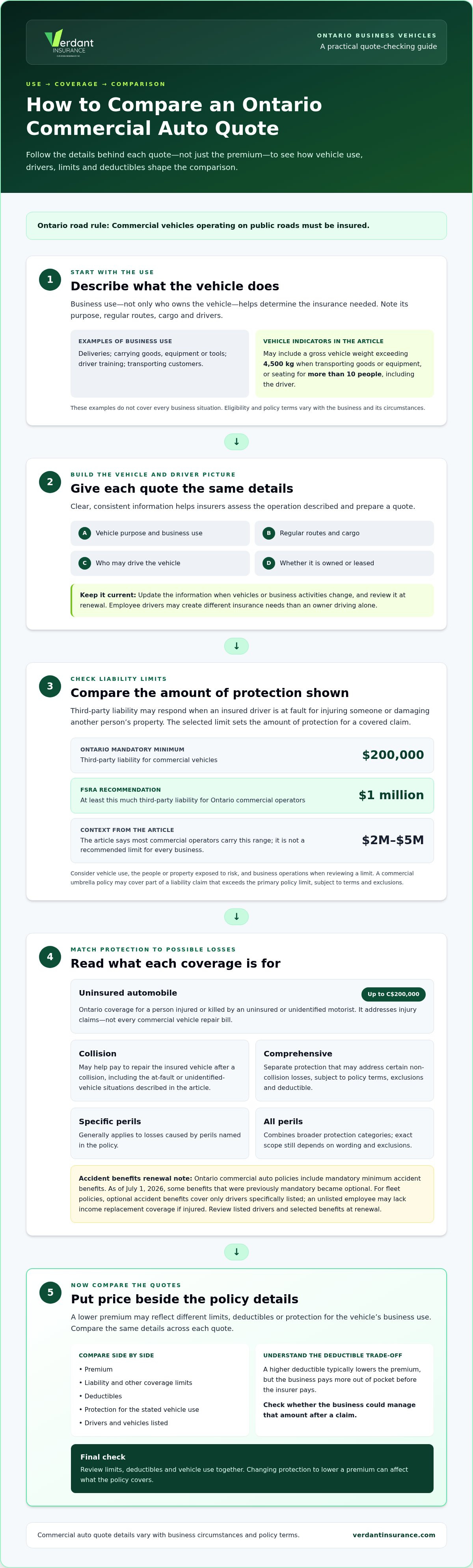
A vehicle’s business use, not just who owns it, helps determine the insurance needed. In Ontario, commercial vehicles operating on public roads must be insured.
Business Vehicle Eligibility
Commercial auto eligibility depends on how a vehicle is used, what it carries, and who drives it. In Canada, a commercial motor vehicle may have a gross vehicle weight exceeding 4,500 kgs when used to transport goods, materials, merchandise, equipment, or tools. It may also have seating capacity for more than 10 passengers, including the driver.
These examples can help identify commercial vehicle use, but they don’t cover every business situation. Before reviewing coverage, note the vehicle’s purpose, regular routes, cargo, and drivers. Eligibility and policy terms vary based on the business and its circumstances.
Businesses Requiring Commercial Coverage
Deliveries, transporting goods or equipment, driver training, and transporting customers are examples of business uses that may require commercial auto insurance. A contractor’s van carrying tools, a bakery’s delivery vehicle, and a vehicle transporting paying passengers each have a distinct use to describe.
Consider both vehicle use and who can drive it. Employees using a company vehicle may create different insurance needs than an owner driving alone. Commercial coverage can provide more specialized protection for multiple drivers than a personal auto policy.
Liability Coverage for Business Vehicles
Ontario law requires commercial vehicles operating on public roads to be insured. The mandatory minimum third-party liability coverage is $200,000. FSRA recommends that Ontario commercial operators carry at least $1 million in third-party liability coverage.
Liability coverage may respond when an insured driver is at fault for injuring someone or damaging another person’s property. The selected limit determines how much protection applies to a covered claim. Consider vehicle use, the people or property exposed to risk, and your business operations when choosing a limit.
When Umbrella Insurance May Fit
A commercial umbrella policy may cover the part of a liability claim that exceeds the limit of the primary business liability policy. For example, if a covered claim exceeds the underlying limit, umbrella protection may apply to the excess, subject to policy terms and exclusions.
Most commercial operators carry $2M-$5M in third-party liability coverage. That range provides context, not a recommended limit for every Ontario business. Review how the primary policy and any umbrella policy work together, including their limits and covered activities.
Ways to Manage Small Business Insurance Costs
Start with accurate information: list each vehicle, its business purpose, its drivers, and whether it’s owned or leased. Clear details help insurers assess the risk and prepare a quote based on the operation described. Update the information when vehicles or business activities change, and review it at renewal.
A higher deductible typically lowers a business insurance premium, but the business pays more out of pocket before the insurer pays. Compare deductible options with the amount your business could manage after a claim. Review coverage limits and vehicle use together too, since changing protection to lower a premium can affect what the policy covers.
Uninsured and underinsured automobile coverage
For a business vehicle, review protection for injuries and vehicle damage separately. Ontario policies include uninsured automobile coverage, while collision, comprehensive, and other optional protections address different types of loss.
Uninsured and Underinsured Motorist Protection
Ontario uninsured automobile coverage provides up to C$200,000 if a person is injured or killed by an uninsured or unidentified motorist. This protection addresses injury claims, not every repair bill for a commercial vehicle. Check the policy wording to understand who is insured and which situations qualify.
Collision coverage may help pay to repair a business vehicle damaged in an at-fault collision or hit by an unidentified vehicle. Uninsured automobile coverage and collision coverage serve different purposes. Compare each coverage, its deductible, and the people and vehicles it applies to.
Mandatory and Optional Commercial Coverage
Ontario commercial auto policies include mandatory minimum accident benefits. These benefits may help pay eligible medical and rehabilitation expenses for an insured person or employee injured in an auto-related accident, regardless of fault.
As of July 1, 2026, some accident benefits that were previously mandatory became optional for auto policies. Commercial policies renewing after the changes retain their current coverage, while optional benefits apply only to specified people. For fleet policies, optional accident benefits cover only drivers specifically listed on the policy, so an unlisted employee may lack income replacement coverage if injured. Review the listed drivers and selected benefits during renewal.
Collision, Comprehensive, and Perils
Collision coverage relates to damage to the insured vehicle from a collision, including the at-fault or unidentified-vehicle situations described above. Comprehensive coverage is separate and may address certain non-collision losses, subject to the policy’s terms, exclusions, and deductible. Neither coverage label alone describes every event that’s covered.
Specific-perils coverage generally applies to losses caused by perils named in the policy. All-perils coverage combines broader protection categories, but its exact scope still depends on the wording and exclusions. Before choosing protection for a work van or delivery vehicle, compare the listed events and deductibles, not just the coverage name.
Rideshare Use and Platform Driving
Personal auto insurance typically doesn’t cover a vehicle used for ridesharing. If you use a vehicle for Uber or Lyft trips as well as business errands, describe both uses when arranging coverage. Platform activity can differ from ordinary business travel, so don’t assume a commercial policy automatically covers every trip.
For each vehicle, note whether it carries goods, serves customers, or makes rideshare trips. Then compare liability coverage, accident benefits, collision, and comprehensive protection with those uses. Actual protection depends on insurer eligibility, policy wording, limits, and exclusions.
Factors affecting commercial auto insurance costs
Ontario commercial auto premiums are based on details about each vehicle, driver, business use, and selected coverage. There’s no fixed average that applies to every business. A delivery van used daily in Toronto and a work vehicle used occasionally in a less busy area present different rating factors.
Driver information can affect the premium. Insurers consider driving records and experience, including those of employees who use company vehicles. Provide accurate driver details and update them when regular drivers change. For example, adding an employee to your driving roster changes the information used to assess risk.
Vehicle type and use matter too. The number of vehicles, whether each is owned or leased, and what it transports help describe the risk. A vehicle carrying tools between job sites has a different purpose from one making frequent deliveries. Repair and replacement costs can also influence pricing because the vehicle’s value and repair needs affect the potential cost of a claim.
Coverage choices also shape the premium. Liability limits, optional protections, and deductibles affect both the policy’s cost and what the business pays after a covered loss. A higher deductible typically lowers a business insurance premium, but the business pays more out of pocket before the insurer pays. Compare deductible options with the funds available to handle a claim.
Where and how often a vehicle travels can influence its risk profile. Traffic density is one factor: a vehicle regularly operating on busy Toronto streets may be rated differently from one used on quieter routes. Transport distances, delivery frequency, and service areas help explain day-to-day exposure. Describe these uses clearly, rather than noting only that the vehicle is business-owned.
To understand a quote, review its inputs in a consistent order: vehicle type and count, ownership or lease status, business use, drivers, coverage limits, and deductibles. Compare these details at renewal too. If an employee’s driving role, a vehicle’s route, or its transported equipment has changed, updated information gives the insurer a more accurate basis for reassessment.
There’s no single average cost that applies to every Ontario business. Premiums vary based on the vehicles, drivers, business use, location, coverage, and deductible choices.
Discount eligibility and bundling
Discounts can affect commercial auto insurance costs, but availability and eligibility vary by insurer and business circumstances. A claim-free, conviction-free driving history may be relevant when an insurer assesses a business’s risk. It doesn’t make a discount automatic: the insurer’s terms and policy details matter.
Start by gathering clear information about the business’s driving history. Note claims, convictions, and changes to the drivers using each vehicle. For example, include it in your policy review if an employee starts driving a company vehicle. Accurate details help a broker identify possible discounts and avoid comparing quotes based on different information.
Bundling means placing more than one eligible policy with the same insurer. A business might ask about combining commercial auto coverage with business insurance, while an owner may also have homeowner coverage. Whether a combination is available or changes the premium depends on the insurer and policies involved. Bundling doesn’t automatically cost less than separate policies.
Compare bundled and separate options on equal terms. Check that each quote reflects the same vehicles, drivers, business purposes, liability limits, and deductibles. Then compare the total premium with the coverage in each policy. A combined quote may look different because it includes more coverage, not because a discount reduced the cost.
Ask for discount details to be shown clearly in the quote comparison. Identify the policy or vehicle receiving each discount, the eligibility condition, and whether it continues at renewal. If one insurer’s quote reflects a claim-free driving history and another’s doesn’t, the premiums aren’t comparable until the information matches.
A broker can organize details across insurer options and explain differences in discount terms. Bring a current vehicle list, driver information, and details of policies you may want to bundle. For a business with a work van and a separate homeowner policy, this offers a practical starting point without assuming both policies qualify for a combined offer.
Before choosing, weigh any discount against the full policy. Confirm the listed drivers and business purposes, then compare limits, deductibles, and exclusions. Record the selected coverage and discount conditions for renewal. If the business’s driving history or policy mix changes, revisit the comparison instead of assuming last year’s discount will continue.
Comparing Ontario commercial auto insurance quotes
Commercial auto insurers in Ontario assess different vehicle types, business uses, and driver profiles. The insurers available for a particular operation depend on its details, so compare actual policy terms rather than relying on a general insurer list.
Start with a consistent description of your business. List each vehicle, whether it’s owned or leased, its main purpose, and the employees or owners who drive it. Include how it’s used, such as carrying tools, making deliveries, or travelling between customer locations. Quotes based on occasional local trips and frequent deliveries won’t be directly comparable.
Next, line up the coverage in each policy. Compare liability limits, accident benefits, collision and comprehensive coverage, deductibles, and exclusions that affect the stated business use. A lower premium may reflect a lower limit or higher deductible. Check what each policy covers before treating the price difference as a saving.
Use a simple comparison table to keep the details visible:
- Vehicles: Record each vehicle and its ownership or lease status.
- Drivers: Compare the listed owners and employees, including who regularly drives.
- Use: Match the described transport, delivery, customer, or job-site activities.
- Protection: Set out limits, deductibles, and included coverage side by side.
- Premium: Compare the total cost only after the other details align.
Review driver eligibility carefully. One quote may be based on a particular set of listed drivers, while another assesses a different roster. If both an owner and an employee drive for a small business, confirm that both are listed as intended. For multiple vehicles, check that each has the correct use and coverage details.
Read exclusions and conditions alongside the coverage summary. A policy label doesn’t explain every limit on a claim. Look for wording that applies to your actual operations, including who can drive and how the vehicle is used. If quotes have different limits, understand their practical effect before choosing.
Finally, compare quotes using the same information and ask for differences to be explained in plain language. An Ontario commercial auto insurance quote is useful when it reflects your business’s actual drivers, vehicles, and work. A broker can organize insurer options and clarify differences in policy terms.
Verdant Insurance: Auto Insurance
Verdant Insurance helps Ontario drivers and business owners explore auto insurance options suited to their vehicle use. If you use a vehicle for work, share its business purpose, who drives it, and the coverage you’re considering. These details help inform a commercial auto insurance review and comparison of available policy options.
Verdant Insurance is a brokerage, not an insurer. Its Auto Insurance and Business Insurance offerings can help with personal and business coverage needs. Terms, coverage, and eligibility vary by insurer and individual circumstances.
For help considering your Ontario auto or business insurance options, contact Verdant Insurance or visit verdantinsurance.com.
Make your next quote decision with confidence
Turn your comparison into a brief decision record. Note which policy terms suit your operations and the trade-offs behind your choice. This gives you a clear reference when your business needs change.
A commercial auto insurance quote in Ontario is most useful when it supports a considered decision, not just a quick price comparison. Keep your priorities clear as you review options and choose what suits your business.
If you’d like help reviewing your options, you can speak with a Verdant Insurance broker.
A thoughtful review is a practical step toward choosing coverage with confidence.
Frequently Asked Questions
What affects commercial auto insurance quotes in Ontario?
Insurers consider vehicle details, business use, location, annual kilometres, coverage choices, and driver information. Claims history and driving experience may also affect their assessment. For example, changing from local service calls to frequent deliveries may alter how an insurer views the vehicle’s use. Keep business and vehicle details consistent when comparing quotes, so differences reflect policy options rather than mismatched information.
How can I get a commercial auto insurance quote in Ontario?
To get a commercial auto insurance quote in Ontario, prepare details about your business, vehicles, and drivers, then submit them through an insurer or broker. Include the work each vehicle supports and the coverage you want considered. A broker can compare insurer options and explain differences. Review the resulting policy terms before choosing, rather than relying on the premium alone.
What coverage is required for commercial vehicles in Ontario?
Commercial vehicles operating on Ontario public roads must be insured. Ontario’s mandatory minimum third-party liability coverage is C$200,000, and commercial auto policies also include mandatory minimum accident benefits. These requirements are a baseline, not a full assessment of a business’s needs. Consider the vehicle’s activities, who may drive it, and the potential consequences of an at-fault claim when reviewing coverage limits.
What optional coverages are available for Ontario commercial auto insurance?
Options can include collision, comprehensive, and replacement vehicle protection, depending on the insurer and policy terms. Ontario policy endorsements may address specific needs: OPCF 20 can cover transportation replacement costs after a commercial vehicle is damaged or stolen, while OPCF 27 concerns liability for damage to a borrowed or rental vehicle. Compare each option’s limits, conditions, and exclusions against the way your business operates.
How do commercial auto insurance rates compare across Ontario insurers?
Rates can differ between insurers for similar vehicles and drivers because each applies its own rating factors and eligibility rules. Verdant Insurance works with 16 insurance companies in Ontario. When comparing options, align the vehicle details, listed drivers, coverage limits, and deductibles first. Then consider how policy wording and exclusions differ. A premium comparison is meaningful only when you understand what each insurance policy provides.
What information do I need to get a commercial auto insurance quote?
Gather your business name and contact details, vehicle identification and ownership information, and a description of each vehicle’s work use. Prepare information for owners and employees who drive, including their driving histories. Also note where the vehicles operate, annual kilometres, and any known claims history. These details help produce a quote that reflects your actual operations, rather than an incomplete vehicle description.
How can businesses lower commercial auto insurance premiums in Ontario?
Review deductible options: a higher deductible typically lowers the premium but increases what the business pays before the insurer pays. Ask whether placing eligible policies with the same insurer may qualify for a multi-policy discount; eligibility and discount amounts vary by insurer. Keep vehicle and driver information current, and compare equivalent coverage before changing limits or removing protection to reduce costs.
How do vehicle type, business use, and driver history affect Ontario commercial auto rates?
Vehicle type helps insurers assess repair and replacement exposure, while business use shows how the vehicle is operated. A van carrying equipment between job sites differs from a vehicle making regular customer deliveries. Driver experience and records also shape the risk assessment. Provide accurate details for each vehicle and driver, since changes to routes, work duties, or the driving roster can affect the quote.


