

Students in Ontario may qualify for discounts based on their studies, driving experience, vehicle use, or policy arrangements. Car insurance discounts for students in Ontario are not a standard offer, so compare quotes using the same driver and vehicle details. You can request a free quote online or work with an Ontario insurance brokerage.
It’s understandable to want a clearer picture before choosing a policy. A premium is only one part of the decision: the quoted coverage, deductible, listed drivers, and vehicle use also shape whether an option fits your needs. Keeping those details consistent helps make comparisons more useful.
This guide explains how student circumstances can affect discount eligibility and what to consider when comparing quotes. It covers academic qualifications, driver training, family-policy arrangements, student driving routines, and online applications. Use the points that apply to your situation to prepare for a focused comparison and choose coverage that reflects how you drive.
Key Takeaways
- Find out which driver-training records and academic details may help you qualify for student discounts.
- Learn when staying on a parent’s policy while away at school could be an option, and why the student’s access to the car matters.
- See how your commute, where the car is kept, and your driving habits can affect insurance considerations.
- Understand what to compare when looking for student auto insurance online in Ontario, beyond the quoted premium.
- Explore how an Ontario insurance brokerage can help you review auto insurance options for your circumstances.
1. Driver training discounts for young or new drivers
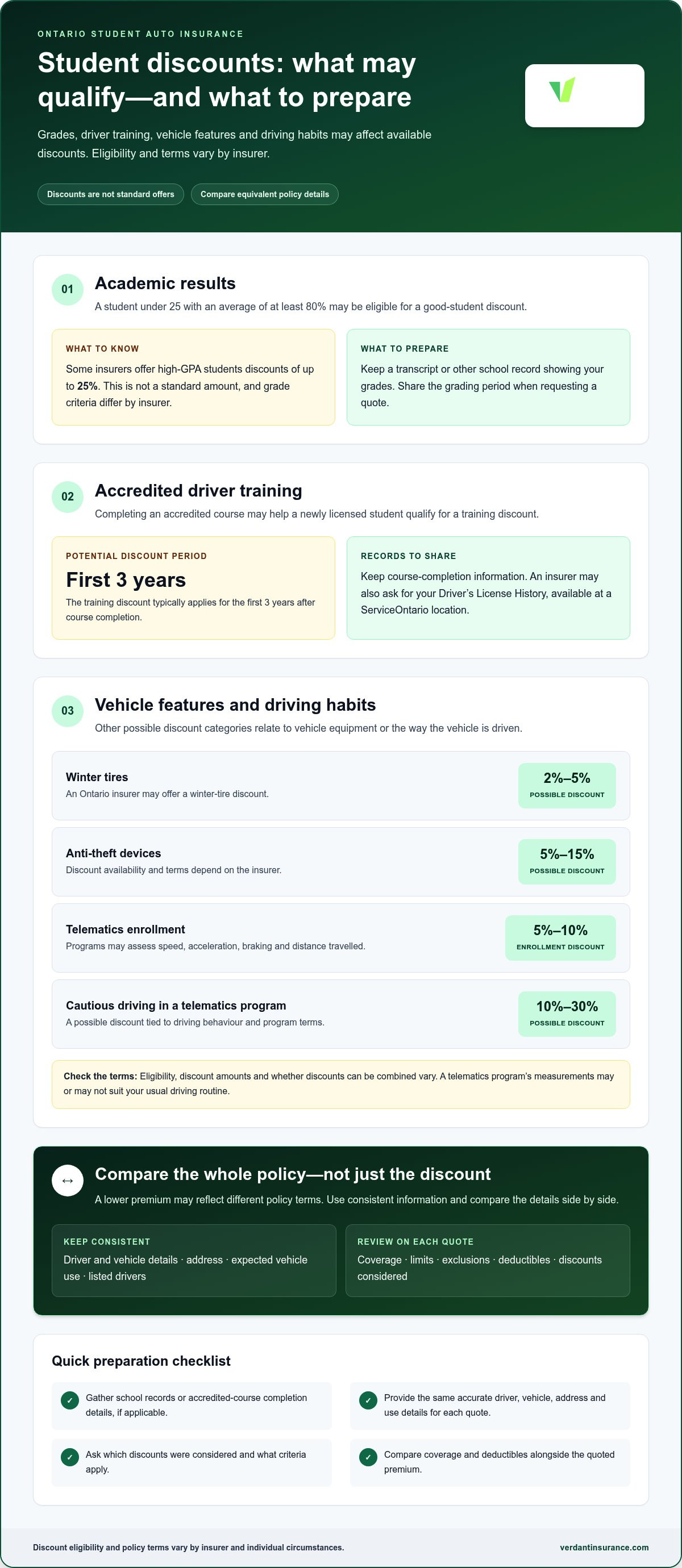
Ontario students may qualify for discounts based on academic results or driver training. These car insurance discounts for students in Ontario can apply to different circumstances, so identify each qualification separately. A student under 25 with an average of at least 80% may be eligible for a good-student discount. Completing an accredited driver-training course may also help a newly licensed student qualify for a training discount.
Some insurers offer high-GPA students discounts of up to 25%. That is not a standard discount amount across insurers. Eligibility and discount terms depend on the insurer’s criteria, so don’t assume that a particular grade average produces the same result everywhere. Keep a transcript or other school record showing your grades, and share the grading period with the insurer when you request a quote.
For a driver-training discount, keep information showing that you completed an accredited course. The discount typically applies for the first 3 years after course completion. An insurer may also ask for your Driver’s License History. In Ontario, you can obtain this record at a ServiceOntario location. Provide the course and driving-history details when requesting a quote or updating an existing policy.
First, identify the discount you may qualify for. Gather your academic records if applying based on grades, or course-completion details if you have finished driver training. Share the information with the insurer or brokerage and ask which discounts were considered. Requirements vary by insurer, so compare car insurance discounts for students in Ontario without assuming that every provider uses the same criteria.
Other discounts may relate to the vehicle or driving habits. Ontario insurers may offer a winter-tire discount of 2% to 5%, and anti-theft device discounts may range from 5% to 15%. Telematics programs may provide an enrollment discount of 5% to 10%; cautious driving could earn a discount of 10% to 30%. Each option has its own terms, and eligibility and combinations vary.
For example, a newly licensed student might have completed accredited training, earned an average above 80%, and use winter tires. Those details could relate to separate discount categories, but they don’t guarantee a combined reduction. Ask for each qualifying detail to be considered, then compare the premium alongside the coverage and deductibles. A telematics program may assess speed, acceleration, braking, and distance travelled, so consider whether its driving measurements suit your routine.
Keep copies of any records you provide and note when you completed training. If your grades, vehicle, or driving routine changes, update the information used for your quote. Clear records help you explain which qualifications apply and compare available options accurately.
2. Where can I buy student car insurance?
Ontario students can request auto insurance quotes online or work with an insurance brokerage. An online application lets you enter your information directly, while a brokerage can compare options from multiple insurers and explain the differences. For example, a student buying a first vehicle can compare quotes before choosing suitable policy details. Whichever route you take, provide consistent information about the driver, vehicle, address, and expected use.
Discounts and eligibility vary by insurer and individual circumstances, and location can affect premiums. A student in Toronto may receive a different quote from someone in Markham, even with similar driving experience. Insurers also consider driving history, vehicle, annual kilometres, vehicle use, claims history, and selected coverage. Provide the same accurate details with each quote request.
Young drivers may face higher premiums because insurers consider driving experience and other individual risk factors. The vehicle, where it is usually kept, and how it is driven can also affect a quote. Compare policies with matching driver and vehicle information, coverage, and deductibles. Otherwise, a lower premium may reflect different policy terms rather than an equivalent option.
To compare quotes, gather the driver’s licence details, vehicle information, address, and expected use. Identify everyone who regularly drives the car, including a student sharing it with a parent. Provide details of any applicable discounts, then review each quote’s coverage, limits, exclusions, and deductibles. Looking beyond the premium gives you a more useful basis for comparing options.
Driving habits may also affect available options. Telematics programs can assess patterns such as speed, acceleration, braking, and distance travelled. Before choosing one, review how it uses driving information and what its terms say about participation. A student who drives occasionally around campus should consider whether the program’s measurements reflect their usual routine.
The deductible affects the balance between your premium and out-of-pocket costs after an insured loss. A higher deductible can reduce a premium, but you would pay more yourself when a claim applies. Compare deductibles alongside coverage and policy wording, and consider what amount you could manage after vehicle damage. Compare the whole policy, not just one figure.
Students living in a rental apartment or residence can also compare auto insurance with tenant insurance. Placing more than one type of policy with the same insurer may qualify for a multi-policy discount, depending on insurer rules. To discuss Ontario auto insurance options that reflect your circumstances, you can review auto insurance options with Verdant Insurance.
3. Staying on a parent's policy while living away
A student under 25 who is listed on a parent’s auto insurance policy may qualify for an away-at-school discount if they temporarily live elsewhere for school and have limited access to the car. The distance between the school and the family home can also affect eligibility. For example, a student living in residence several hours away, with occasional use of a family vehicle, has a different arrangement from a student who takes a car to campus.
Before a student moves, tell the insurer where they will live during the school term and how they will use any household vehicle. Explain whether they will drive only during visits home or have regular access while away. Provide the school location and expected vehicle arrangements accurately. These details help the insurer assess eligibility under its away-at-school discount rules.
If the student takes a car to school, list them as its primary driver. The policy should reflect who regularly drives the vehicle, where it is kept, and how it is used. For instance, if a student takes a family car to a Toronto campus and uses it most days, tell the insurer rather than assuming a parent remains the main driver.
A parent may be able to add a student’s car to an existing policy if the car is registered in the parent’s name. Insuring multiple vehicles in one household may qualify for a multi-vehicle discount. Some insurers may also allow a parent’s and teenager’s vehicles on separate policies with the same insurer to qualify. Compare arrangements based on ownership, regular drivers, vehicle locations, and insurer eligibility rules.
Review household policy documents after any change. Check that the student, vehicle, school-term address, and driver roles are recorded accurately. Compare the revised household premium and policy terms with a separate student policy, paying attention to deductibles, limits, and exclusions. A lower household total does not necessarily mean the student’s individual coverage needs are addressed in the same way.
Digital policy tools can help families keep track of documents and policy information. If the insurer offers an app or online account, use it to review available records. Do not assume the app lets you make every change. Follow the insurer’s process for updating drivers, addresses, or vehicle use, and save revised documents so the family can refer to current details.
Review the arrangement when the student returns home, changes schools, or starts using a different vehicle. For example, their access to a family car may increase during a school break. Tell the insurer when a change affects where the car is kept or who drives it regularly. Keeping policy details aligned with the student’s routine supports an accurate review of coverage and premiums.
4. Commuter, urban and residence student driving profiles
A student’s weekly driving pattern helps describe how a vehicle is used. A commuter may drive regularly between home and school, while a student in residence may use a family car only occasionally. Share the main destination, usual driving frequency, and where the vehicle stays overnight when comparing quotes. Pricing and discount availability vary by insurer and location.
For a commuter, describe the actual trip rather than giving a broad estimate. Say whether the drive is to campus, work, or both, and whether the student drives regularly. For example, a student driving from Vaughan to a Toronto campus has a different routine from one who takes transit and uses a car on weekends. Accurate details help insurers assess how the vehicle is used.
Urban driving can involve busy streets, frequent stops, and varied parking arrangements. Tell the insurer where the car is usually kept, such as in a garage, driveway, or student parking lot. Do not assume an urban address automatically means a particular premium or discount. Quotes reflect the information provided and the insurer’s rating approach, so compare using the same address and vehicle details.
A student in residence who rarely drives should describe that pattern clearly. Note how often the car is available, whether the student drives during school breaks, and where it is kept during term. Parents can help gather details from existing household policies. If the student’s schedule changes, update the insurer instead of relying on an outdated estimate.
Safe driving matters across each profile. In 2021, distracted driving accounted for 22.5% of fatalities and 25.5% of serious injury collisions across Canada. Keep attention on the road, leave at least a 3-second following distance, and increase it on snowy or icy Ontario roads. Smooth braking and steady attention are practical habits for a commuter’s daily trip or an occasional drive from residence.
Students considering usage-based insurance should understand what the telematics program measures. Programs may monitor speed, acceleration, braking, and distance travelled. Before enrolling, review how driving information is used and how the program’s terms affect participation. A student taking short trips around campus has a different pattern from one commuting daily, so consider whether the measurements reflect typical use.
To prepare for a quote, note the vehicle’s usual location, the student’s school and commute, and who drives it regularly. Include seasonal changes, such as driving home during school breaks. Compare policies using consistent details, then review coverage, limits, exclusions, and deductibles. A clear driving profile helps match the quote to the student’s routine rather than assumptions based only on age or address.
5. Ontario online car insurance discount
An online quote can help you share information and compare options, but discounts may depend on details beyond the application itself. Distinguish the digital application from discounts based on student status, training, vehicle, or driving habits. For example, entering course details helps describe your record, but the insurer still applies its own eligibility rules when calculating the premium.
Start with the details needed for an accurate quote: the student’s licence information, vehicle details, address, and expected use. Include all regular drivers and explain whether the student commutes to school or drives occasionally. If the car is shared with parents, describe who uses it most. Consistent information matters because differences in drivers or vehicle details can change the quote and make comparisons less useful.
As you complete an online application, answer questions about discounts fully. Mention any applicable student status, completed training course, winter tires, anti-theft device, or telematics participation. If the form has no clear place to enter a detail, use the insurer’s stated contact option to provide it. Do not assume an empty field means the discount was included.
Compare quotes using matching details: vehicle, drivers, address, use, coverage, limits, deductibles, and policy period. Then compare the premium and policy wording, not just the first price displayed. For instance, a quote with a different deductible or coverage selection may appear cheaper without being equivalent. Save or download each quote to review its terms.
Before submitting personal information, confirm that you are using the intended insurer or brokerage website. Check the web address, use a secure connection, and avoid sending licence or vehicle documents through an unverified channel. Keep a record of the application, quote reference, and documents provided. This makes it easier to follow up if a discount or driver detail appears differently in the final documents.
Ask whether a discount is tied to applying online or to a qualifying driver, vehicle, or policy feature. These are different bases for a price adjustment. For example, a student who applies online and has completed accredited training should identify each factor separately rather than treating the online application as proof of a discount. Review coverage, exclusions, and listed drivers before proceeding.
Use the online process to organize your details and compare equivalent options. A clear record of the student’s driving habits, vehicle use, and discount information makes comparisons more meaningful. The final premium and available discounts depend on the insurer’s criteria and the information provided.
Verdant Insurance: Auto Insurance
Verdant Insurance can help Ontario students review auto insurance options and understand how their driving profile may affect a quote. As an insurance brokerage, it can compare available insurer options using details such as the student’s vehicle use, school commute, driver-training history, and family policy arrangements. This can be useful when a student is buying coverage for the first time or their circumstances have changed.
Share relevant details about the vehicle, regular drivers, and discounts you are seeking. Eligibility, pricing, and policy terms depend on insurer rules and your circumstances, so review the resulting coverage and documents carefully. Request a free auto insurance quote from Verdant Insurance to explore options in Ontario.
Make your next policy review count
Your insurance needs can change as school, housing, and vehicle use change. Treat each move or new driving routine as a reason to review your policy details. A short list of current drivers, vehicle use, and student circumstances can make that review more focused. A careful review of car insurance discounts for students in Ontario considers both the premium and whether the policy fits how you drive now.
Discounts, pricing, and eligibility depend on the insurer and individual circumstances. Verdant Insurance offers auto, homeowner, and business insurance, helping Ontario households consider multiple coverage needs through one brokerage.
Take the next step with clear information in hand, and feel more confident about choosing coverage that suits your situation.
Frequently Asked Questions
Where can I buy student car insurance?
Students can buy car insurance online from an insurer or through an Ontario insurance brokerage. An online application lets you submit information directly, while a brokerage can compare options from multiple insurers and explain differences. For example, a student moving from a parent’s vehicle to their own car can request quotes with matching vehicle, address, and coverage details. This makes the options easier to compare on equal terms.
How much is car insurance in Ontario?
There is no standard premium for Ontario students. Insurers calculate quotes using details such as driving record, experience, vehicle, location, annual kilometres, vehicle use, claims history, and selected coverage. For example, a student who occasionally drives an older car may receive a different quote from one commuting daily in another vehicle. Compare equivalent policy details.
Do Ontario insurers offer a good student discount, and what grades qualify?
Yes, some Ontario insurers offer a good-student discount. A student under 25 with an average of at least 80% may be eligible, though insurer criteria differ. Ask the school for a transcript or other record showing the relevant grades, and identify the grading period covered. If your marks use a letter or GPA scale, provide the school’s grading information so the insurer can assess it accurately.
How much can students save with a good student discount in Ontario?
There’s no single discount amount that applies across Ontario. Some insurers offer high-GPA students discounts of up to 25%, but that figure is not a standard reduction for every student or policy. The actual offer depends on the insurer’s rules and the student’s circumstances. When comparing quotes, check the premium with the discount applied and confirm whether the quoted coverage and deductible match your other options.
Do Ontario insurers offer discounts for students living away from home without a car?
Some insurers offer an away-at-school discount when an eligible student remains listed on a parent’s policy and has limited access to a vehicle while temporarily living elsewhere for school. A student living in residence who occasionally uses a family car, for example, has a different situation from one taking a vehicle to campus. The school’s distance from home can also affect eligibility, so provide accurate living and vehicle-use details.
Can students get a discount for taking an approved driver education course in Ontario?
Yes, completing an accredited driver-training course can help a newly licensed student qualify for a discount. The discount typically applies during the first 3 years after course completion. Keep course-completion information available, and ask what documentation the insurer needs. An insurer may also request the student’s Driver’s License History. Course approval and discount terms depend on the insurer, so include the training details when comparing quotes.
How do telematics or usage-based insurance discounts work for Ontario students?
Telematics programs assess driving information that may include speed, acceleration, braking, and distance travelled. Insurers use program rules to evaluate driving patterns and determine any applicable discount. A student who drives infrequently should consider whether the measurement period reflects their usual routine. Before deciding whether usage-based insurance suits you, review how driving data is collected and used, along with the program terms.
Can students save by staying on a parent's car insurance policy in Ontario?
Sometimes. A parent’s policy may be an option if the student’s vehicle is registered in the parent’s name, and insuring multiple household vehicles may qualify for a multi-vehicle discount. Some insurers also allow a parent’s and teenager’s vehicles on separate policies with the same insurer to qualify. Compare the household arrangement with a separate student policy, and list the student as the primary driver of any car they take to school.


