

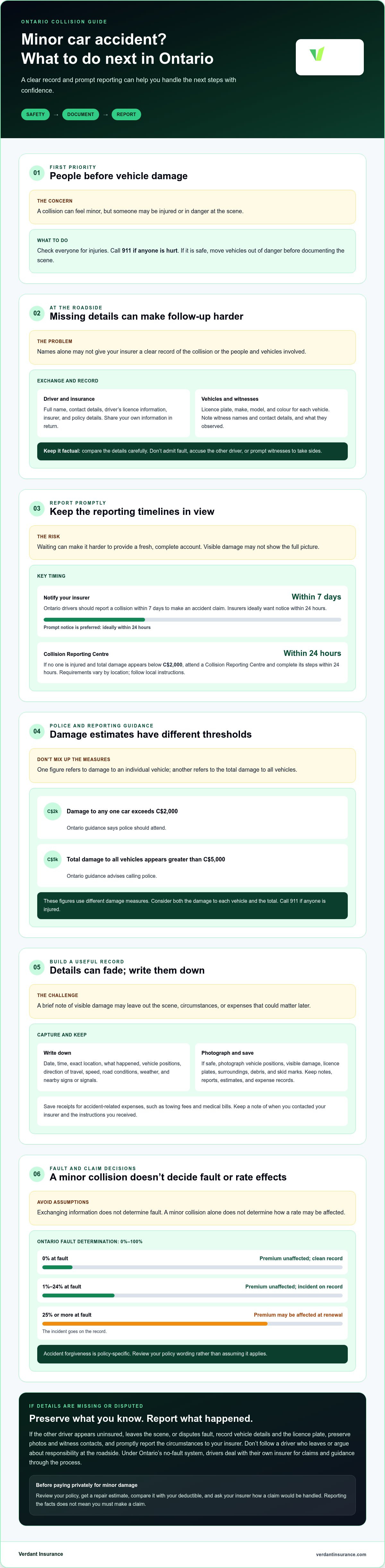
A minor collision still calls for clear, deliberate action. The steps to take after a minor car accident in Ontario are to check for injuries, call 911 if anyone is hurt, move to a safe spot if possible, exchange driver and insurance details, document the scene, and notify your insurer promptly. If no one is injured, follow the applicable collision-reporting steps and keep a record of the information you collect.
It’s understandable to focus first on visible damage, but symptoms or questions about coverage can surface later. This guide explains how to secure the scene, what details to exchange, when to report the collision, and how Ontario statutory accident benefits may help with eligible expenses after an injury. You’ll also learn why benefits can matter regardless of who caused the crash, and how policy choices affect some benefits for accidents after July 1, 2026. Taking these steps can help you protect everyone’s safety and make the next decisions with greater clarity.
Key Takeaways
- Check everyone for injuries first, and call 911 if anyone needs help.
- Move vehicles out of danger when it’s safe, then document the scene and damage.
- Exchange driver, vehicle, and insurance details, and record what happened while it’s fresh.
- Notify your insurer promptly and keep records of accident-related expenses.
- Learn which statutory accident benefits may help with eligible expenses, even when fault is disputed.
What information is exchanged in a car accident?
Exchange identifying, vehicle, and insurance details with the other driver, then notify your insurer. These records document the collision and help support the next steps in an Ontario claim.
-
Exchange Driver and Insurance Details
Ask the other driver for their full name, contact details, driver’s licence information, and insurance company and policy details. Share your own information in return, and compare the details carefully before leaving. Under Section 200 of Ontario’s Highway Traffic Act, drivers involved in a highway accident must provide specified identification and insurance information when requested. Keep the exchange factual, and don’t admit fault or accuse the other driver.
-
Share Vehicle and Witness Information
Record each vehicle’s licence plate, make, model, and colour, including any additional vehicles involved. Note where the vehicles were positioned, and photograph the damage if it’s safe. Ask witnesses for their names and contact details, and record what they observed without prompting them to take sides. Someone who saw the traffic signal or vehicle movements may help clarify what happened later.
-
Notify Your Insurance Company
Contact your insurance company as soon as possible to report what happened and ask about the next steps. Ontario drivers should report a collision within 7 days to make an accident claim; insurers ideally want notice within 24 hours. Provide the date, location, other driver’s details, vehicle information, and any photographs. Keep a note of when you called and the instructions you received.
-
Understand Fault and Possible Rate Effects
Ontario’s fault determination rules can assign a driver anywhere from 0% to 100% fault. In Ontario, drivers found 0% at fault have unaffected premiums and a clean record; those found 1-24% at fault have unaffected premiums, but the incident goes on their record. At 25% or more fault, premiums may be affected at renewal, and the incident goes on the record. A minor collision alone doesn’t determine the rate effect. Accident forgiveness is policy-specific, so review your policy wording rather than assuming it applies.
-
Respond to Missing or Disputed Information
If the other driver appears uninsured, leaves the scene, or disputes fault, record their vehicle details and licence plate, preserve photographs and witness contacts, and promptly report the circumstances to your insurer. Don’t follow a driver who leaves or argue about responsibility at the roadside. Under Ontario’s no-fault system, drivers deal with their own insurer for claims and guidance through the process. The insurer assesses the information under applicable rules. Exchanging details does not determine fault.
What to do after a car accident in Ontario?
The steps to take after a minor car accident in Ontario include reporting the collision promptly, following applicable police or Collision Reporting Centre instructions, and keeping useful records. What to do next depends on injuries, apparent damage, and where the collision happened.
-
Report the Collision
Contact your insurance company promptly and ask how to proceed with a claim. Ontario drivers should report a collision within 7 days to make an accident claim; insurers ideally want notice within 24 hours. If no one is injured and total damage appears below C$2,000, attend a Collision Reporting Centre. You’ll be asked to complete a police report, and vehicle damage will be photographed for your insurer.
Take the vehicle to the centre if it can be driven. If it needs towing, check with the centre about where the vehicle should be taken. Bring your driver’s licence, vehicle ownership, insurance details, accident notes, and information about the other people involved. Complete these centre steps within 24 hours after the collision.
-
Check Whether Police Must Attend
Call 911 if anyone is injured, and report the collision to police as soon as possible. Ontario guidance advises calling police if total damage to all vehicles appears greater than C$5,000. It also says police should attend when damage to any car exceeds C$2,000. These figures use different damage measures, so consider both each vehicle’s damage and the total.
Answer police questions honestly. Describe what you observed, but don’t speculate, admit fault, or blame another driver. Injuries and estimated damage matter even when a collision seems minor. Collision Reporting Centre requirements vary by location, so follow the instructions for where the crash happened.
-
Document the Collision Details
While details are fresh, record the date, time, exact location, and how the collision happened. Note vehicle positions, direction of travel, speed, road conditions, weather, and nearby traffic signals or signs. If safe, photograph each vehicle’s position, visible damage, licence plates, and surroundings, including any debris or skid marks.
Keep photographs and notes with the police report or Collision Reporting Centre paperwork. Save records of accident-related expenses, such as towing fees and medical bills. These details give your insurer a clearer account of events and may support its assessment.
-
Decide How to Handle Minor Vehicle Damage
Before paying out of pocket, review your policy and get a repair estimate. Compare it with your deductible, then ask your insurer how a claim would be handled under your coverage. A small dent can conceal damage, so document what you see and report the collision promptly instead of relying only on visible damage.
As part of the steps to take after a minor car accident in Ontario, keep written estimates, receipts, and any agreement with the other driver if you’re considering private payment. Reporting the facts to your insurer helps clarify your options; it doesn’t mean you must make a claim. Your policy wording, deductible, and the circumstances of the collision all affect the decision.
Immediate safety and injury checks
Check yourself, passengers, and others for injuries before focusing on vehicle damage. Call 911 if anyone is hurt, and get medical attention for symptoms that appear later.
- Check for injuries and call 911. Look for bleeding, pain, confusion, dizziness, or difficulty moving. Ask passengers whether they feel hurt, but don’t assume everyone is uninjured because they can walk or speak. If anyone is injured, don’t move them. Call 911, follow the operator’s directions, and wait for help. Avoid giving food or drink to an injured person while waiting for emergency responders.
- Watch for delayed symptoms. Some symptoms, including concussion, internal trauma, or whiplash, may appear 24 to 48 hours after a collision. Consider seeing a doctor even if you feel well immediately afterward, especially if pain, nausea, headache, or dizziness develops. Describe the collision and when each symptom began. Keep notes about medical visits and changes in your condition, so you can share a clear timeline during an accident-benefit claim.
- Ask about accident benefits if you’re injured. Ontario’s statutory accident benefits are available through your own insurance regardless of who caused the collision. Eligible benefits can include medical and rehabilitation expenses, attendant care, and income replacement. Income replacement benefits provide 70% of gross income, up to C$400 per week. Contact your insurance company to report the injury and ask how to start an application. Keep medical documents, treatment records, and receipts for accident-related expenses organized for the claim.
- Understand the Minor Injury Guideline and seek legal advice when needed. The Minor Injury Guideline cap for Ontario accident benefits is C$3,500 for injuries that fall within that category. The cap does not describe every injury or every benefit, so don’t assume it sets the amount available for all claims. If your injuries are serious, your recovery is disputed, or you’re considering a legal claim, consult a lawyer about your circumstances before making decisions about settlement. Keep copies of medical records and insurance correspondence to support those discussions.
Securing the accident scene and checking for injuries
Stop immediately, assess your surroundings, and protect people from passing traffic. Safety comes before photographs or other scene documentation.
- Stop and assess immediate hazards. Keep your vehicle stopped after the collision, then check traffic, visibility, and the road surface before opening a door. Turn on hazard lights to alert approaching drivers. Look for smoke, leaking fluids, broken glass, or a vehicle blocking a live lane. If you see an immediate danger, move away only when you can do so safely and call 911 for emergency help.
- Move vehicles only when it’s safe. If the vehicles can be driven safely, move them to the shoulder or another safe place away from traffic. Don’t move a vehicle with serious damage, smoke, leaking fluids, or an injured occupant inside. If it can’t be moved, turn on the hazard lights and use traffic warnings if available. Don’t stand between vehicles or in an active traffic lane.
- Stay belted if the vehicle cannot move safely. Remain inside with your seatbelt fastened when exiting would expose you to traffic or another hazard. Check whether passengers can stay safely seated, and avoid walking around the vehicle to inspect damage. If the vehicle’s position creates danger, call 911 and follow the operator’s directions. Exit only when the surrounding area is safe to reach.
- Check people before inspecting vehicles. Ask passengers and other people involved whether they’re hurt, and look for visible injuries. If anyone is injured, don’t move them; call 911, follow directions, and wait for help. Don’t focus on collecting evidence while someone needs emergency care. Once immediate safety is addressed, note where each vehicle stopped and any visible road hazard, such as debris or a blocked lane.
- Collect scene evidence from a safe position. Once traffic and injuries are under control, photograph each vehicle’s position before moving it, if safe. Take clear images of the damage, wider road scene, nearby signs, and relevant debris. Record what happened, including each vehicle’s direction of travel and any road or weather conditions you observed. Keep the original images and notes together, and don’t step into traffic for a better angle.
Ontario statutory accident benefits
Ontario statutory accident benefits can support eligible people injured in a collision. They are handled separately from decisions about who caused the crash or assessments of vehicle damage.
- Start with your own insurer. In Ontario’s no-fault insurance system, an injured person deals with their own insurer for accident-benefit claims, regardless of who caused the collision. “No-fault” describes how benefits are accessed; it doesn’t mean fault is never assessed. Fault determination rules still apply to the collision. Contact your insurer, report the injury, and ask how to start the benefits process.
- Identify the type of support you need. Statutory accident benefits may include medical and rehabilitation expenses, attendant care, and income replacement. Treatment costs and care needs, for example, relate to different benefit categories. Explain how the injury affects daily activities and work, and keep records linking each expense or request to the collision. The insurer assesses the claim based on the information provided and the applicable policy.
- Understand which benefits apply to your accident date. For Ontario accidents after July 1, 2026, entitlement to accident benefits other than medical and rehabilitation benefits and attendant care benefits depends on optional benefits purchased by the policyholder and the claimant’s ability to claim under that policy. Ask which benefits are included in the relevant policy and whether the injured person can claim under it. The policy and claimant’s connection to it matter.
- Keep one organized claim record. Save medical documents, receipts for accident-related expenses, insurer correspondence, and notes about symptoms or treatment. Include the collision report from a reporting centre, if completed, as well as the other vehicle’s plate number and witness details when relevant. A dated record can help explain how the injury developed after the crash and why particular expenses relate to it.
- Address disagreements through the claim process. If the insurer disputes eligibility, the benefit category, or an expense, ask why and keep its written response with your records. Compare the decision with the policy and information you submitted, then respond with relevant documents or clarification. Ontario accident-benefit disputes may be brought to the Licence Appeal Tribunal (LAT). Keep copies of each submission and decision for reference.
Verdant Insurance: Auto Insurance
Verdant Insurance is an Ontario brokerage that helps drivers explore Auto Insurance options suited to their needs. After a collision, you may have questions about your policy, deductible, or how coverage is described. Verdant’s insurance brokers can explain available options and help identify relevant policy details. Actual coverage depends on the insurer, policy wording, limits, and exclusions.
Consider speaking with an insurance broker when reviewing your coverage, preparing for renewal, or comparing your needs with your current policy. For an active claim, contact your insurer directly and follow its claim instructions.
Contact Verdant Insurance to discuss your Auto Insurance needs in Ontario.
Make your next insurance decision with clarity
Once the immediate demands of a collision have passed, consider what you want from your insurance going forward. The steps to take after a minor car accident in Ontario can prompt a practical review of your driving needs and questions about your policy. An insurance broker can explain available options, but does not take the place of your insurer in an active claim.
Verdant Insurance offers Auto Insurance, Homeowner Insurance, and Business Insurance. Ontario drivers can reach out to review their auto coverage or get help understanding insurance options for their circumstances.
A collision can be unsettling, but it can also help you make more informed choices. When you’re ready, take the next step and move forward with greater confidence.
Frequently Asked Questions
What's considered a minor car accident?
A minor car accident may involve a low-speed impact, little visible damage, and no serious injuries. Examples include a parking-lot fender bender, a rear-end collision in traffic, or a scrape while turning or parking. These examples describe how a crash may appear; they don’t guarantee that no one is hurt or that repairs aren’t needed. Reassess the situation if new symptoms or unexpected damage appear.
How is Fault Determined?
Ontario’s Fault Determination Rules assign responsibility from 0% to 100% based on the collision circumstances and the applicable rule. To help preserve a clear account, sketch the lanes and vehicle directions while you remember them, and note any signal or sign involved. For example, mark where each car was before a turning collision. A driver’s opinion at the roadside does not itself decide the formal fault assessment.
How soon do you have to report a car accident?
Report a collision to your insurance company within 7 days to make an accident claim; insurers ideally want notice within 24 hours. Have your policy details and a concise description ready, including where the cars were travelling and what happened. Ask what information the insurer needs next, and keep a note of the date you reported the collision and any claim reference provided.
Should I see a doctor after a car accident if I feel fine?
Consider seeing a doctor even if you feel fine immediately after the collision. Symptoms such as concussion, internal trauma, or whiplash may emerge 24 to 48 hours later. If discomfort develops, note when it started and how it affects ordinary activities, then report it to your health insurance provider. A dated symptom record can help you give a clearer account during medical appointments.
What accident benefits may be available after a car accident?
Ontario statutory accident benefits may include medical and rehabilitation expenses, attendant care, and income replacement. For accidents after July 1, 2026, benefits beyond medical and rehabilitation benefits and attendant care depend on optional benefits purchased and whether the claimant can claim under that policy. If an accident-benefit decision is disputed, the Licence Appeal Tribunal (LAT) is a route for disputes. Keep the insurer’s written decision with your claim records.
What should I do immediately after a minor car accident in Ontario?
Stop, check whether anyone needs help, and make the scene safer before focusing on vehicle damage. Once it’s safe, collect the other driver’s name, licence and contact details, insurance information, and vehicle details. Note witnesses’ contact information and each vehicle’s licence plate, make, model, and colour. Keep the exchange factual. Don’t agree on fault at the roadside or let gathering information delay urgent help.
How do I report a car accident to an Ontario collision reporting centre?
Attend the Collision Reporting Centre with your vehicle when the applicable reporting instructions require it. Bring your driver’s licence, vehicle ownership, insurance details, accident notes, and information about the other people involved. If you arrive outside normal business hours, contact the centre the next business day; the vehicle can be left there overnight. Keep any paperwork or reference information from the visit with your claim records.
When should I call police or 911 after a car accident in Ontario?
Call 911 if anyone is injured. Ontario guidance advises calling police when total damage to all vehicles appears greater than C$5,000, and says police should attend when damage to any car exceeds C$2,000. These are separate damage measures, so consider both the apparent damage to each vehicle and the combined total. If injuries or damage make the collision more than a minor incident, don’t rely on its appearance alone.


