

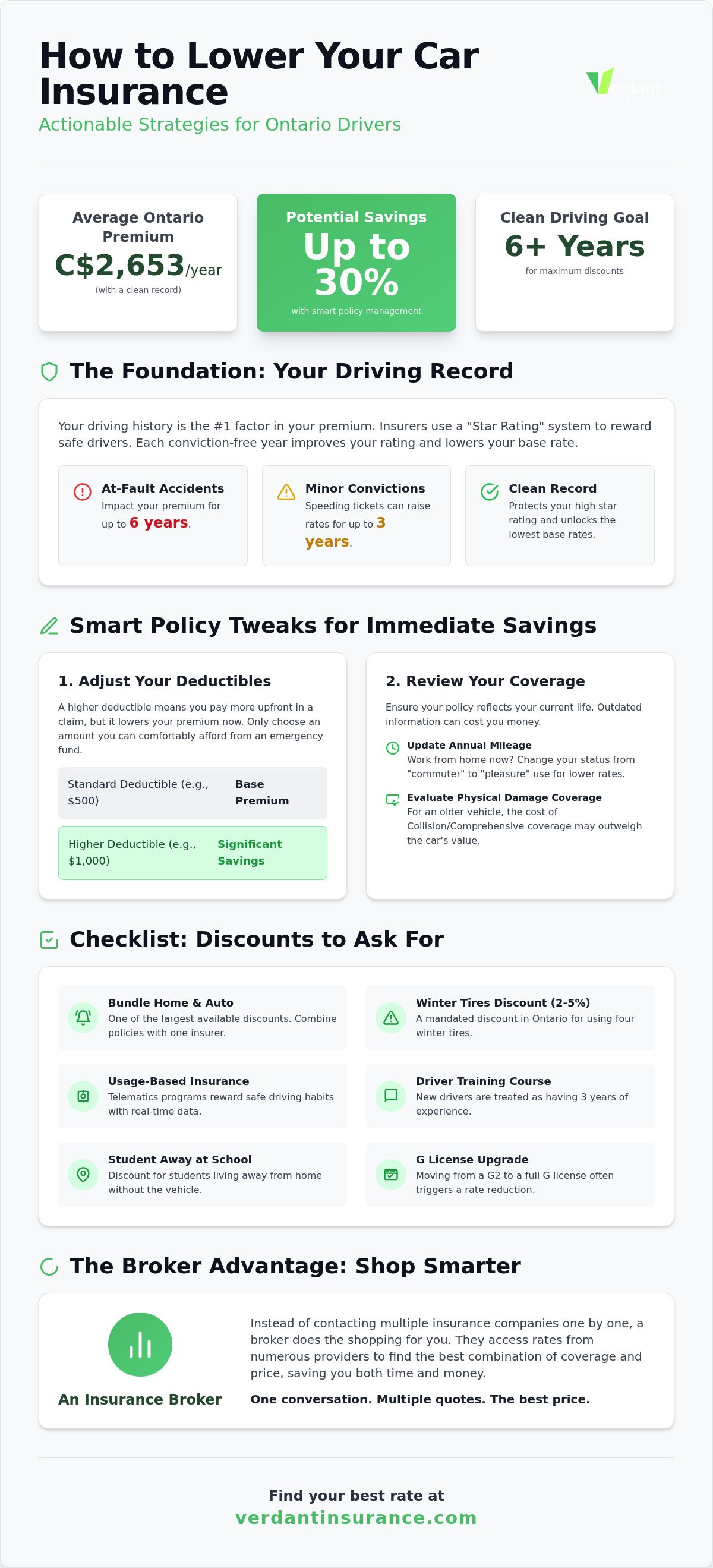
Did you know the average Ontario driver is now paying C$2,653 per year for auto insurance, even with a spotless driving record? It's frustrating to feel like your loyalty isn't being rewarded while premiums continue to climb. If you're tired of squinting at confusing terms like "endorsements" or "deductibles" on your renewal notice, you aren't alone. Most drivers feel stuck with their current rates because the system feels built to be complicated, but you don't have to accept a high bill as a given.
We're here to help you take back control of your budget. This guide shows you exactly how to lower car insurance by using 15+ actionable strategies that can save you up to 30% through smart, proactive policy management. We'll provide a clear checklist of discounts you should ask for and explain how to navigate the major July 2026 regulatory changes with confidence. You're about to learn how to trim your annual bill while ensuring you have the exact level of protection your family needs.
Key Takeaways
- Discover why maintaining a clean driving record in Ontario is the foundation of long-term savings and how avoiding minor convictions keeps your rates low.
- Learn how to lower car insurance by strategically adjusting your deductibles and evaluating if "Optional Physical Damage" coverage is still necessary for your older vehicle.
- Understand the "Broker Advantage" and how accessing multiple quotes through a single provider like Verdant Insurance saves you both time and money.
- Explore how vehicle safety ratings and specific life stage discounts, such as the "Student Away at School" credit, can significantly reduce your annual costs.
- Find out if you qualify for a 30% discount as a claim-free and conviction-free driver through customized policy options tailored to your budget.
Mastering the Basics: Driving Habits that Lower Premiums
Your driving record is the single most influential factor in determining your premium. In Ontario, insurers look closely at your history to predict future risk. If you have a clean slate, you're seen as a low-risk partner, which is the most effective way to understand how to lower car insurance over the long term. Safe driving isn't just about avoiding accidents; it's about building a financial profile that rewards your reliability.
Most Ontario companies use a "Star Rating" system, typically ranging from 0 to 9. Each year you drive without an at-fault accident or conviction, you move up a level. Reaching a high star rating unlocks the lowest possible base rates. Progress is fragile. A single minor conviction, like a speeding ticket for going 15 km/h over the limit, can halt your progress or even drop your rating, costing you hundreds over several years.
If you're a safe driver who doesn't spend much time on the 401, you might benefit from usage-based insurance programs. These telematics tools track your braking, acceleration, and speed in real-time. For many Ontario residents, this technology provides an immediate discount just for signing up. You'll then have the potential for deeper savings at renewal if your data proves you're a cautious driver who stays within the limits.
Maintaining a Clean Driving Record
To reach maximum discounts, you generally need six years of clean driving history. It's vital to distinguish between types of incidents. Not-at-fault accidents generally won't hike your rates, but at-fault collisions stay on your record for six years. A single minor traffic ticket can increase your insurance rates for up to three years. Avoiding these small mistakes is often more valuable than any other discount because it protects your high star rating.
In Ontario, using winter tires isn't just a safety choice; it's a regulatory requirement for a discount. Most insurers are mandated to provide a reduction of around 2% to 5% if you have four winter tires installed during the colder months. Combining this with a clean record creates a solid foundation for your savings strategy.
Driver Training and Continuous Education
New drivers can jumpstart their savings by completing an MTO-approved beginner driver education course. This isn't just about safety; it's a financial strategy that allows insurers to treat a new driver as if they have three years of experience. Completing these courses is one of the most reliable ways to learn how to lower car insurance costs right from the start of your driving career.
As you progress through Ontario's graduated licensing system, moving from a G2 to a full G license often triggers a rate reduction. Even experienced drivers can benefit from ongoing education. Many insurers offer credits for senior driver refresher courses, acknowledging that staying current with modern road rules reduces overall risk.
Optimising Your Policy: Strategic Adjustments for Immediate Savings
Adjusting your policy settings is often the fastest route to seeing a smaller number on your monthly statement. While your driving record takes years to build, your policy structure can be updated in minutes. If you're wondering how to lower car insurance without changing your vehicle, start by reviewing your current coverage limits. Many Ontario drivers carry "standard" settings that haven't been updated to reflect their current financial reality or driving frequency.
Look at your mileage first. If you've shifted to a hybrid work model, you might still be paying for a daily 50-kilometre commute that you no longer make. Updating your status from "commuter" to "pleasure" or simply reducing your annual estimated kilometres can lead to a noticeable price drop. Additionally, bundling your home and auto insurance remains one of the most effective ways to secure double-digit savings. Most insurers offer a significant discount when you trust them with multiple lines of business.
Adjusting Your Deductibles Wisely
A deductible is the amount you pay out of pocket before your insurance kicks in. By taking on a bit more of the initial risk, you can lower your ongoing costs. According to the official Ontario insurance regulator, increasing your deductible is a primary way to manage your premiums. However, this is only a good idea if you have an emergency fund ready. Don't set a C$1,000 deductible if a surprise C$1,000 bill would cause a financial crisis.
| Deductible Amount | Estimated Savings (Collision Portion) |
|---|---|
| C$500 | Baseline Rate |
| C$1,000 | 15% to 25% Reduction |
| C$2,000 | 30% or more Reduction |
Removing Unnecessary Coverage
As your vehicle ages, the cost of certain coverages might no longer make sense. Many experts suggest the "10% Rule": if the annual cost of your collision and comprehensive coverage exceeds 10% of your car's total value, it's time to consider dropping them. For a car older than 10 years, the maximum payout you'd receive after an accident might be less than what you've paid in premiums and deductibles over just a few years.
Review your endorsements, too. You might be paying for OPCF 20, which covers the cost of a rental car while yours is being repaired. If you have a second vehicle or can easily rely on public transit for a week, you can safely remove this to save more. A quick chat with a professional at Verdant Insurance can help you identify which endorsements are truly essential for your lifestyle and which are just adding extra weight to your bill.
The Broker Advantage: Why Shopping Around is Your Best Move
Many drivers assume that staying with the same company for a decade is the best way to secure a low rate. In reality, the insurance market is constantly shifting. An insurance agent works for a single company and can only offer you their specific products. An insurance broker, however, works for you. By partnering with a broker, you gain an ally who scans the entire Ontario market to find which carrier currently has the most competitive rates for your specific profile. This is a fundamental step in how to lower car insurance because it forces companies to compete for your business.
You might fall into the "Renewal Trap" if you simply sign your policy every year without looking elsewhere. Insurance companies frequently adjust their "risk appetite." A company that offered the best rates for a 30-year-old driver in London two years ago might not be the most affordable choice for that same driver today. Brokers like Verdant Insurance monitor these market fluctuations in real-time, ensuring you aren't paying a "loyalty tax" while better options are available just a phone call away.
Market Comparison in Real-Time
Verdant Insurance connects you with a wide network of partner carriers across the province. Instead of you spending hours filling out ten different forms, we handle the heavy lifting. This bird's-eye view of the industry is one of the most effective ways to lower your insurance costs. While loyalty discounts exist, they're often smaller than the aggressive "new business" pricing offered by a carrier looking to grow their presence in your specific city or town.
Beyond the price tag, having a broker provides a layer of professional advocacy. If you ever need to navigate the complexities of the July 2026 regulatory changes during a claim, you aren't stuck talking to a generic call centre. You have a dedicated guide who understands the fine print and works to protect your interests.
Customizing Your Risk Profile
A broker’s job is to dig deeper than a standard online algorithm. We look for niche discounts that are often buried in technical manuals. Are you a member of a specific professional association? Do you work for a large employer with a group rate? These small details can lead to significant annual savings that a direct-to-consumer website might miss. We ensure your policy is lean and efficient, focusing your budget on the coverage you actually need.
By tailoring every endorsement to your lifestyle, we prevent you from paying for "ghost coverage" that doesn't apply to your situation. If you're ready to see how much you could be saving, you can get a customized quote from Verdant Insurance today. It's the simplest way to see if your current insurer is still earning your business or if it's time for a better deal.
Life Stages and Vehicle Choice: Long-Term Savings Strategies
Your lifestyle and the vehicle in your driveway are major factors in how to lower car insurance over the long term. While your driving record is personal, insurance companies also look at the statistical risk of the car itself. In Canada, the CLEAR (Canadian Loss Experience Automobile Rating) system ranks vehicles based on how likely they are to be stolen, involved in an accident, or expensive to repair. Choosing a car with a favorable CLEAR rating can save you hundreds of dollars before you even turn the key.
Life changes often bring new opportunities for savings that go beyond your driving habits. Whether you are sending a child to university or transitioning into retirement, your insurance needs shift. Recognizing these milestones allows you to update your policy to reflect your current reality. For example, retirees often see lower rates because they no longer face the risks associated with a daily rush-hour commute, and many insurers offer specific age-based discounts starting at 50 or 65.
Choosing an Insurance-Friendly Vehicle
Before you buy your next car, check the latest high-theft vehicle lists for Ontario. Some popular SUVs and trucks carry heavy surcharges because they are frequent targets for organized theft rings. Conversely, many "safe" family SUVs actually cost less to insure than modest sedans because they have better safety ratings and lower repair costs. If you are considering an Electric Vehicle (EV) or a Hybrid, ask about "green" vehicle discounts. Many Ontario carriers offer a 5% to 10% reduction to reward drivers for choosing environmentally friendly options.
Along with vehicle type, remember that winter tires are a mandatory discount offering for all Ontario insurers. While we discussed this as a habit, it is also a long-term financial strategy. Most companies provide a 2% to 5% discount just for having them installed. Keeping your broker updated on these safety features ensures you aren't leaving money on the table year after year.
Leveraging Life Changes
One of the most overlooked "hidden gems" for parents is the "Student Away at School" discount. If your child is attending a post-secondary institution more than 100 kilometres away and doesn't have a car with them, your premium can drop significantly while still allowing them to drive when they come home for holidays. Similarly, household consolidation through marriage or moving in with a partner allows you to combine policies. These "multi-car" or "multi-line" arrangements are often much cheaper than maintaining two separate accounts.
Your location also plays a massive role. In Ontario, premiums vary wildly by postal code. A driver in Brampton might pay an average of C$3,802 annually, while someone in Beachburg or Petawawa pays around C$1,824 for similar coverage. If you are planning a move, check the insurance implications of your new neighborhood first. Connect with the team at Verdant Insurance to review your vehicle's rating and find hidden life-stage discounts today. It is the most direct way to see how to lower car insurance based on your unique situation.
How Verdant Insurance Helps You Save Up to 30%
Finding how to lower car insurance often feels like a full-time job. At Verdant Insurance, we believe your clean driving record should do the heavy lifting for you. We focus on rewarding Ontario drivers who prioritize safety and responsibility on the road. By combining modern digital tools with the personalized care of a local broker, we make the process of securing a better rate simple and transparent. You get the efficiency of a tech-forward platform without losing the human touch that provides real peace of mind.
One of the most effective ways we help our clients is through multi-line bundling. While many companies offer a small discount for having two cars, we look at your entire insurance portfolio. Whether you need coverage for your home, business, or tenant insurance, we find the carrier that offers the deepest discounts for combining these policies. This holistic approach ensures you aren't just saving on your car insurance, but across your entire financial life. We handle the market research so you can focus on the road ahead.
The Claims-Free Reward
The 30% discount is a specific reward for long-term safe driving habits that have kept you free of claims and convictions. We verify your history through industry-standard reports to ensure you unlock every possible saving you've earned. As your record improves over time, we proactively look for opportunities to transition your policy into more affordable brackets. This ensures your rate stays as low as possible even as market conditions in Ontario shift. We don't just set your policy and forget it; we grow with you.
Start Your Savings Journey
We've streamlined our process to respect your time. You can manage your policy settings online, giving you total control over your coverage without the need for endless phone calls or paperwork. If you ever feel stuck, our proactive guides are ready to assist you in making the right choices for your budget. To get started, follow these three simple steps:
- Visit our website to access our intuitive online quote tool.
- Have your Vehicle Identification Number (VIN), driver's license, and current policy details ready for an accurate assessment.
- Review your customized options and choose the plan that perfectly fits your lifestyle and budget.
It's a straightforward path to significant savings. If you're ready to stop overpaying and start being rewarded for your safe habits, see how much you can save with Verdant Insurance. Our team is standing by to help you navigate the 2026 regulations and find a policy that works as hard as you do.
Take Control of Your Auto Insurance Future
Managing your premiums in Ontario's shifting market doesn't have to be a source of stress. By maintaining a clean driving record and making smart, strategic adjustments to your policy limits, you can keep your costs manageable. Remember that your vehicle choice and current life stage offer unique opportunities for savings that many drivers overlook. Knowing how to lower car insurance is ultimately about being proactive and having the right guide by your side to navigate the fine print.
At Verdant Insurance, we take pride in being that guide. As brokers, we don't work for a single company; we work for you. We shop across multiple partner carriers to find the best market rates while rewarding safe, conviction-free drivers with savings of up to 30%. Our team provides expert local support to ensure your coverage is as unique as your needs, helping you navigate every regulation change with ease.
Start your free Ontario car insurance quote and save up to 30%. You've done the hard work of driving safely, and now it's time to see those efforts reflected in your bank account. We're ready to help you unlock the savings you deserve and give you the peace of mind that comes with a perfectly tailored policy.
Frequently Asked Questions
How much can I actually save by bundling my home and auto insurance?
You can typically save between 10% and 15% on both your home and auto premiums by bundling them with the same insurer. This is one of the most reliable ways to reduce your overall insurance costs because companies want to reward your loyalty for holding multiple lines of business. It also simplifies your life by having one renewal date and one point of contact for all your insurance needs.
Does my credit score affect my car insurance rates in Ontario?
No, your credit score does not affect your auto insurance rates in Ontario. Provincial regulations prohibit insurers from using credit information to determine premiums for car insurance. While it may be used for other types of coverage like home or tenant insurance, your driving record and insurance history remain the primary factors for your vehicle's rate. This ensures the focus stays on your habits behind the wheel.
What is the "winter tire discount" and how do I qualify for it?
The winter tire discount is a mandatory reduction of about 2% to 5% that all Ontario insurers must offer if you install four winter tires during the colder months. To qualify, you simply need to notify your broker or insurer when your tires are on. This discount reflects the reduced risk of accidents during harsh Canadian winters; keeping your receipts or photos of the installation is a good way to verify your eligibility.
Will my insurance go down automatically when I turn 25?
Your rates won't go down automatically on your 25th birthday, but turning 25 often moves you into a lower risk category at your next renewal. Insurance companies view drivers over 25 as more experienced and statistically less likely to be involved in major accidents. If you're looking for how to lower car insurance even further at this age, it's a perfect time to ask your broker for a market review to see if a different carrier now favors your profile.
How long do accidents and tickets stay on my insurance record?
In Ontario, minor traffic tickets stay on your insurance record for three years from the date of conviction. At-fault accidents have a longer impact and typically stay on your record for six years. While these incidents will affect your premiums during that time, their influence gradually decreases as you build a new history of safe, clean driving. Maintaining a spotless record moving forward is the best way to restore your top-tier star rating.
Can a broker really find a lower rate than I can find myself?
Yes, a broker can often find lower rates because they have access to specialized insurance companies that don't sell directly to the public. Instead of you visiting multiple websites, a broker uses advanced technology to compare quotes from several partner carriers simultaneously. This ensures you find the most competitive price for your specific situation while receiving professional advice on how to avoid expensive coverage gaps.
What happens if I increase my deductible but can’t afford to pay it after an accident?
If you increase your deductible to save money but can't afford it after an accident, your vehicle repairs may be delayed or you might have to pay the difference out of pocket. The insurance company only pays for damages that exceed your chosen deductible amount. It's a smart strategy for how to lower car insurance, but you should only choose a deductible that you can comfortably cover with your existing emergency savings.
Is "liability-only" insurance a good way to save money?
Switching to liability-only insurance can save you money by removing collision and comprehensive coverage, but it is only recommended for older vehicles with low market value. If you're involved in an accident where you are at fault, you'll be responsible for all your own repair or replacement costs. For newer or financed vehicles, the financial risk of losing the car entirely usually outweighs the monthly savings on your premium.